The Investigation Protocol
Methodology, Standards & Ethics
How I Approach Genealogy Research
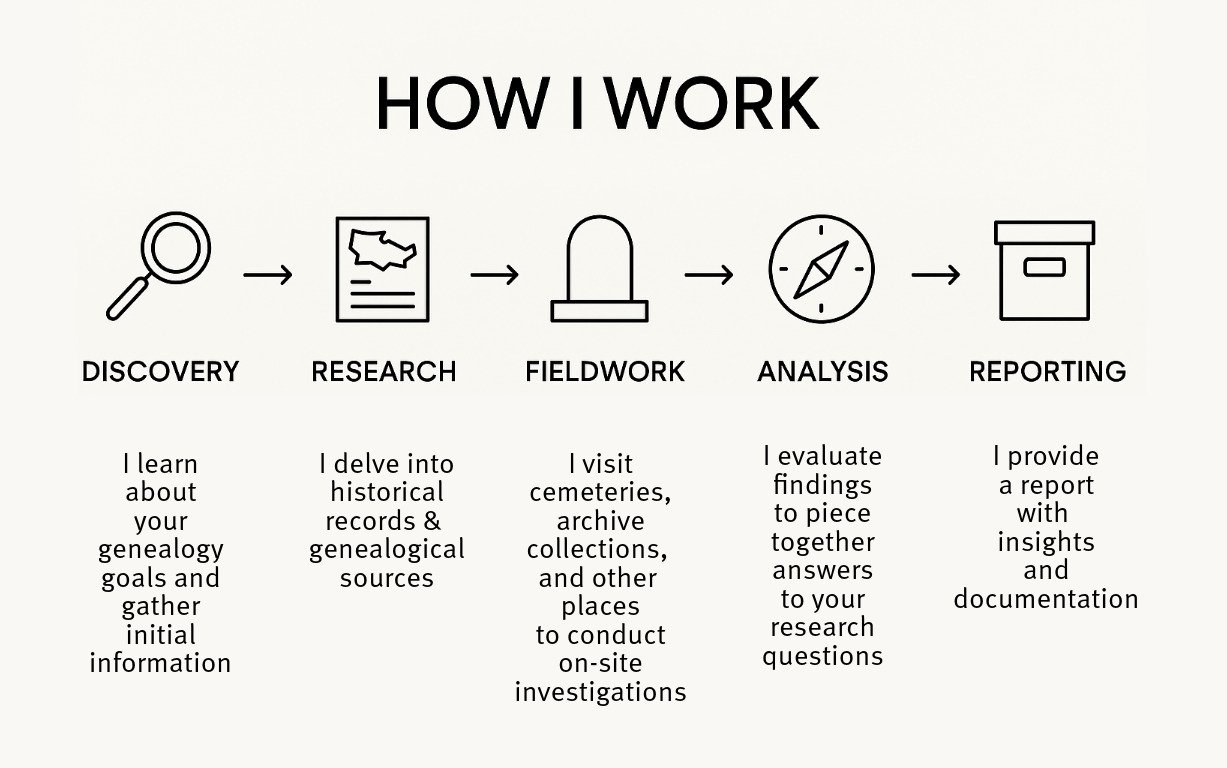
Every family story deserves to be understood with accuracy, dignity, and care. My work blends archival research, cemetery documentation, and on-site fieldwork to uncover ancestors’ lives with clarity and respect.
1. The Philosophy
My guiding principle is written in stone: Every life leaves a trace.
Whether I’m analyzing a probate file, examining a faded death register, or walking the grounds of a forgotten cemetery, my goal is to illuminate the truth with compassion and honesty. I approach every case with:
Forensic Curiosity: I look for what is missing as much as what is present.
Historical Realism: I treat ancestors as real people, not just names on a chart.
Respect for the Dead: I treat every record and every grave with the dignity a final resting place deserves.
2. The Standards
I adhere to the industry standard for genealogical proof. While I do not hold a board certification, I apply the same rigorous testing to every piece of evidence I find. In my line of work, we don't guess. We prove.
2.1 Exhaust the Evidence
I don't stop at the "easy" records. I examine a wide range of sources—vital records, court dockets, tax lists, and local histories—to ensure we aren't missing a clue that changes the verdict.
2.2 Interrogate the Source
Not all records tell the truth. I evaluate every document for bias, informant reliability, and context. I distinguish between what a record says and what it actually means.
2.3 Correlate the Facts
One witness isn't enough. I compare information across multiple documents to find conflicts, agreements, and the patterns that hide in plain sight.
2.4 Resolve the Contradictions
History is messy. When the death certificate says one thing and the tombstone says another, I document the conflict, evaluate the weight of the evidence, and explain the reasoning behind my conclusion.
3. Documentation
If it isn't cited, it didn't happen. Accurate documentation is the backbone of my work.
Full Citations: Every fact is linked to its source, so you (and future researchers) can retrace my steps.
Transcriptions: For difficult 19th-century handwriting or fading text, I provide full transcriptions so you can read the evidence yourself.
4. Fieldwork: Boots on the Ground
This is the defining feature of The Grave Guy™. The library only tells half the story; the rest is out there in the soil.
4.1 On-Site Investigation
When the paper trail ends, I go to the location. This includes GPS mapping of plot locations, condition assessments of stones, and landscape analysis to locate unmarked graves.
4.2 The Code of Conduct
All fieldwork is performed with strict adherence to preservation ethics. No stones are moved, scrubbed with harsh chemicals, or damaged. I leave the site exactly as I found it—only the history is uncovered.
5. Ethical Standards
Ethical research protects both the living and the dead.
Privacy: I strictly protect sensitive information regarding living individuals.
Transparency: I am clear about what is proven, what is probable, and what is merely speculation. I never fabricate a story to fill a gap.
6. The Deliverable
When the investigation is complete, you won't just get a list of names. You will receive a Research Report—a clear, narrative summary of the findings, the evidence that supports them, and the recommended next steps.
7. The Cold Reality
Historical records can be incomplete, damaged, or missing entirely. If the records didn't survive, I will tell you honestly—and then I will offer alternative strategies to find the truth another way.
8. Why It Matters
Family history is a form of storytelling grounded in fact. My protocol ensures accuracy, context, and dignity. Every ancestor deserves the respect of being remembered correctly.
Field Reference Card
Protocol: Evidence-based archival research + On-site fieldwork.
The Rules: Exhaust the search. Question the source. Prove the conclusion.
The Output: Full citations. GPS Mapping. Preservation-focused interaction.