
Twenty Years Chasing Perpetual Motion
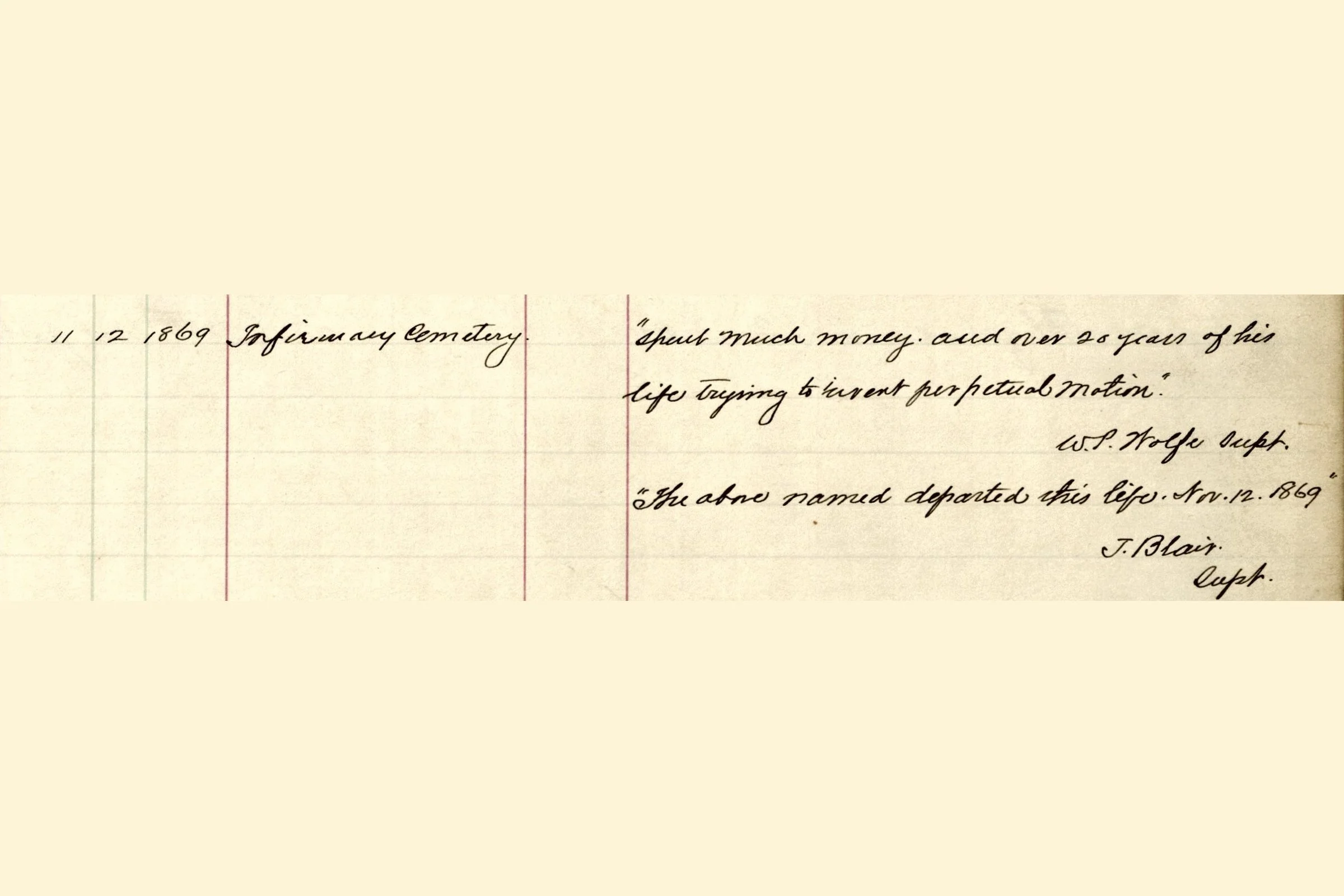
Clinton County Infirmary inmate register, County Infirmary Inmates 1835–1918, Book 1, page 123: the History entry for John Thompson, who died November 12, 1869. Clinton County Records & Archives.
On New Year’s Day 1867, a 72-year-old man named John Thompson was admitted to the Clinton County Infirmary near Wilmington, Ohio. The register leaves most of his line empty. Where he was born: “not given.” Who sent him: “not given.”
Then, on the facing page, in the column headed History, it gives him something most inmates never got:
The note is entered over the name of the superintendent, W. P. Wolfe. Below it, over the name of J. Blair, a second note closes the record: “The above named departed this life. Nov. 12. 1869.” He was buried in the Infirmary Cemetery. In the margin, in a different hand and ink, someone later worked out his birth year: 1869, less 72, is 1797.
When I first read that line, I wasn’t sure what it meant. Was perpetual motion a real invention, or a period phrase for a restless mind or a drinking man? The county’s own newspapers answered it. In Thompson’s lifetime, perpetual motion was a real pursuit: a machine that would run forever without being fed any power.
At first the papers were hopeful. In 1827 the Wilmington Argus reprinted a report of a watchmaker’s brass machine that had been “running about five weeks incessantly.” In 1838 a man advertised that the plan had been “revealed to his mind by a vision,” and offered it to any county for a yearly fee.
By the 1860s the verdict was in. “It is a waste of both time and money,” the Clinton Republican reprinted from Scientific American in 1865. In December 1868, while Thompson was living at the Infirmary, the Wilmington Journal called it an infatuation “so persistent, so universal” that its followers had spent “money and time worse than thrown away.”
The register doesn’t say the chase is what brought him there. It says only what he spent, and for how long. Readers in 1868 would have known what his neighbors thought of it.
From 1835 to 1989, the Infirmary touched nearly 3,000 lives. Most of those people got a name and a date and little else: no obituary, no stone. John Thompson got a sentence. Someone decided that twenty years of a man’s life were worth recording.
Most of us will be summed up the same way, by the people who come after us rather than by ourselves. Relatives fill out death certificates. Families write obituaries. Thompson had no one listed to do either. The register did it for him.
If John Thompson turns up in your family’s papers, whether a letter, a drawing or a name in an earlier census, I would like to hear from you.
Sources: Clinton County Infirmary inmate register, County Infirmary Inmates 1835–1918, Book 1, pp. 122–123 (Clinton County Records & Archives). Wilmington Argus, October 6, 1827, p. 3; Democrat and Herald, September 7, 1838, p. 4; Clinton Republican, April 28, 1865, p. 1; Wilmington Journal, December 9, 1868, p. 2 (all via Newspapers.com).

