
“Voted for Washington Twice”: The Old Soldier of the County Infirmary
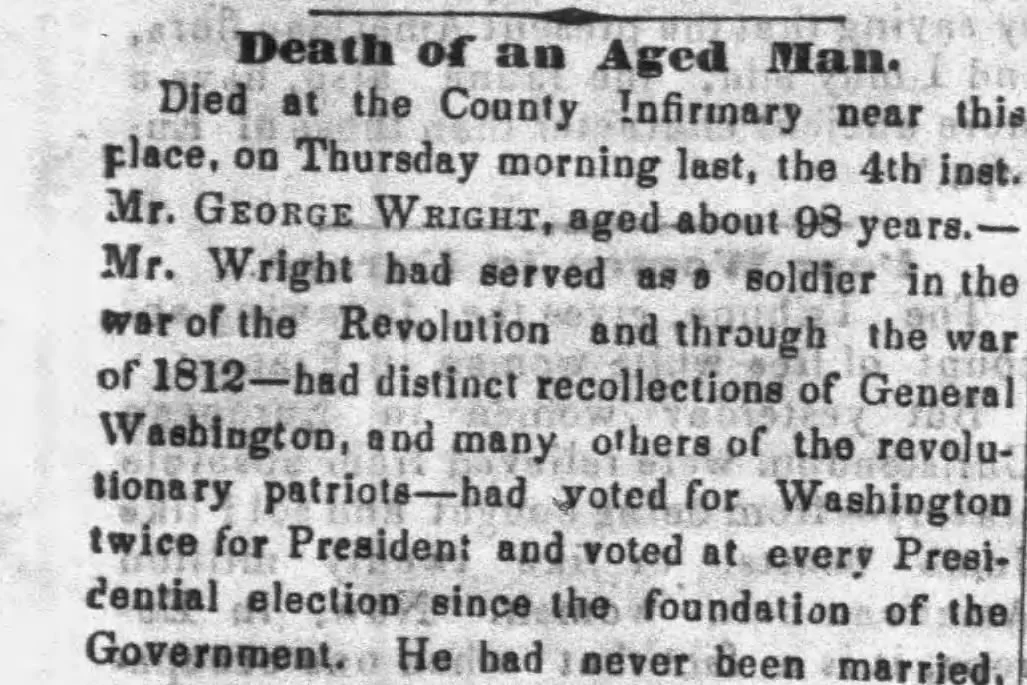
“Death of an Aged Man,” Clinton Republican (Wilmington, Ohio), June 12, 1857, page 2: the notice of George Wright’s death at the County Infirmary on June 4, 1857. Via Newspapers.com; public domain.
Early in 1854, a very old man walked a mile and a half from the Clinton County Infirmary into Wilmington, Ohio, and climbed the stairs to the newspaper office to get the paper. The Clinton Republican gave him a notice of his own. George Wright, it said, would be 95 that August if he lived. He was a native of Ireland, had never married, and had lived at the Infirmary for three years. He read the Republican “regularly and with great avidity,” and his “recollection of dates and circumstances is very accurate.”
He died at the Infirmary on June 4, 1857. The Republican’s notice, “Death of an Aged Man,” gave him more than most residents ever got:
The notice is unsigned. Its writer speaks from the Republican’s office and says he had “the satisfaction of procuring from the government two land warrants for Mr. Wright.” That points to William B. Fisher: an attorney, elected the county’s prosecuting attorney in 1851, and in 1857 co-editor of the Republican with A. P. Russell.
The paper trail survives. Congress’s bounty land act of September 28, 1850, gave land to veterans of the War of 1812, and the warrants name Wright as a private in two Ohio Militia companies of 1812, Captain Sutton’s and Captain Zumwalt’s. The land lay in Illinois. A warrant could be sold, and Wright assigned both, as the obituary put it, “for the benefit of the county, which had given him a home in his declining years.” One went to Humphrey Riddle, the Infirmary’s superintendent. The Infirmary’s printed accounts for the year ending March 1, 1855, record the payment: “From H. Riddle, for land Warrant of George Wright … $94 00.”
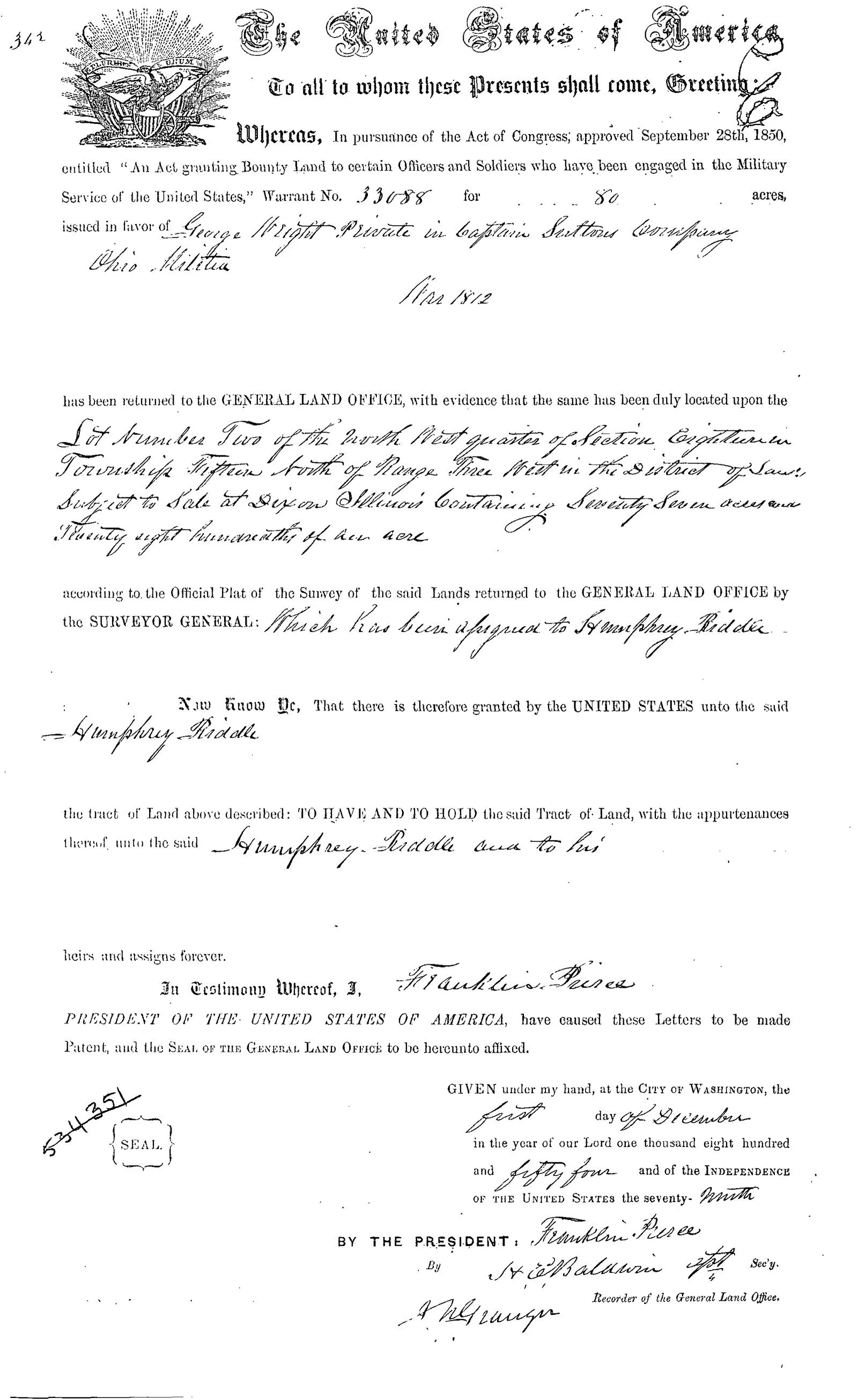
Land patent on Military Bounty Land Warrant No. 33088, December 1, 1854: issued under the Act of September 28, 1850, in favor of George Wright, private in Captain Sutton’s Company, Ohio Militia, War of 1812. The warrant had been assigned to Humphrey Riddle and located on 77.28 acres in the Dixon, Illinois, land district; the patent is issued in the name of President Franklin Pierce. U.S. Department of the Interior, Bureau of Land Management, General Land Office Records, accession MW-0849-342; public domain.
His War of 1812 service is on federal paper. For the Revolution, what survives is Fisher’s word.
The Infirmary superintendent, A. T. Moore, entered Wright’s age at death as 98. He was buried on the Infirmary farm, among the at least 250 people laid to rest there without headstones or recorded grave locations.
The volunteers of the Clinton County Genealogical Society who transcribed the Infirmary’s records were the first to mark him as a soldier of the Revolution. They knew little more, so I went looking. It struck me as profoundly sad that anyone, especially a veteran, could be lost at a county institution.
On June 29, 2026, the Clinton County commissioners adopted a proclamation honoring “these newly identified veterans Walter (Barton) Roberts (d. 1840) and George Wright (d. 1857) of the American Revolutionary War.” On July 1 they presented it near the Infirmary Cemetery site.
I was there that morning with my mother and a family friend. It was calm, and birds sang in the trees that now cover the closed landfill. The commissioners were putting into the record more than fifteen years of the volunteers’ work. Knowing what became of that ground, it was bittersweet. It was also one step toward recovering their lives.
In 1951, General Douglas MacArthur closed his farewell to Congress with a line from an old barracks ballad: old soldiers never die; they just fade away. We can keep them from fading, by learning their lives and putting them in the record. Each life matters.
Fisher ended his notice this way: “Peace to the ashes of the venerable patriot, and quiet old man.”
Sources: “An Old Man,” Clinton Republican (Wilmington, Ohio), March 3, 1854, p. 2; “Death of an Aged Man,” Clinton Republican, June 12, 1857, p. 2; Clinton County Infirmary receipts and expenditures exhibit, year ending March 1, 1855, Clinton Republican, March 9, 1855, p. 3 (all via Newspapers.com). Clinton County Poor House Records [Infirmary Vol. 2], pp. 85–86 (Clinton County Records & Archives). Bureau of Land Management, General Land Office Records, Military Bounty Land Warrants Nos. 33088 and 35782. Clinton County Board of Commissioners, Journal, June 29, 2026, p. 1342 (Resolution #26-670), and July 1, 2026, p. 1358. Douglas MacArthur, address to Congress, April 19, 1951.

