
Built 1897, Rebuilt 1958: What a Date Stone Proves
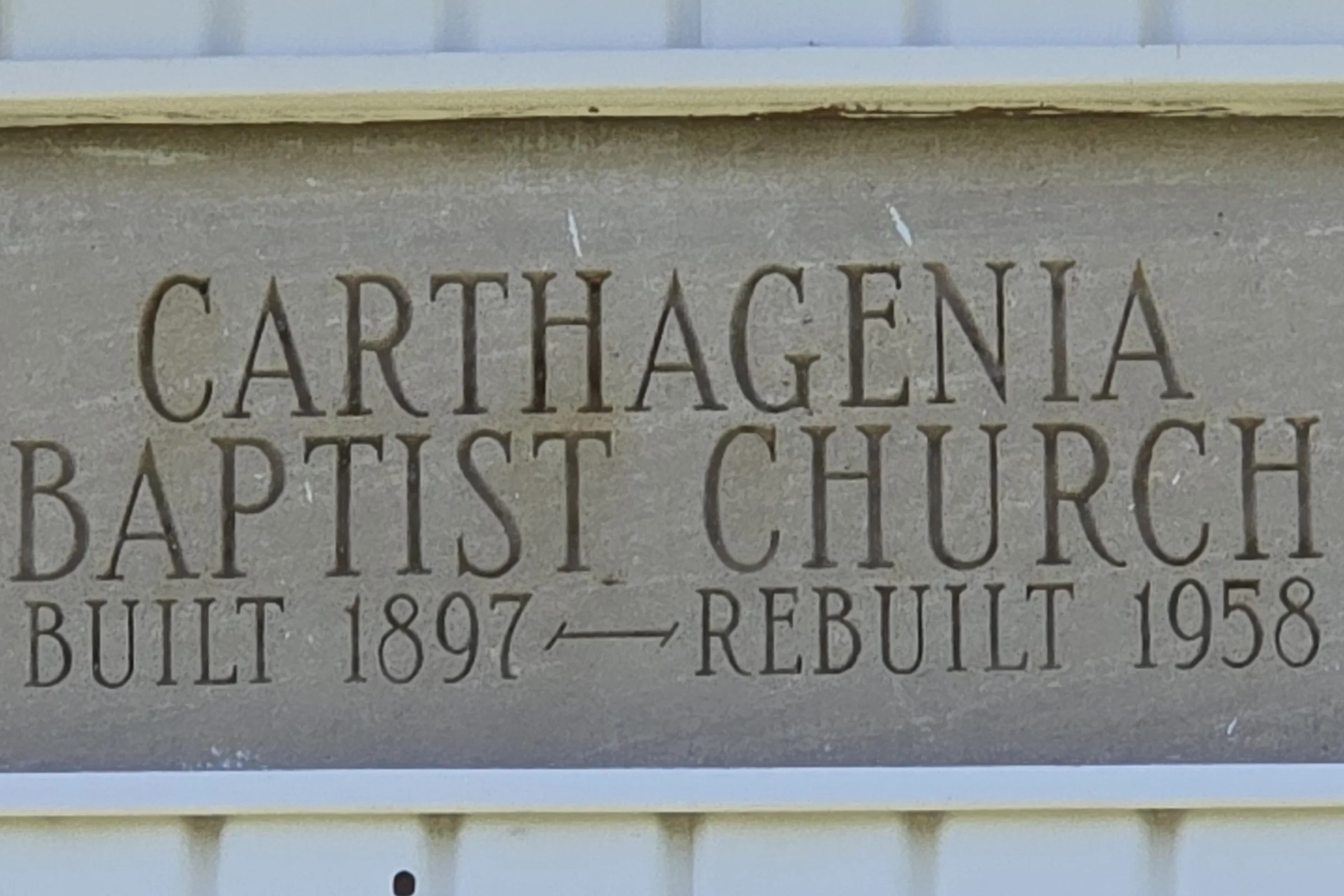
Date stone, Carthagenia Baptist Church, Gist Settlement, Penn Township, Highland County, Ohio, September 26, 2026.
The stone says exactly two things.
“Carthagenia Baptist Church. Built 1897 – Rebuilt 1958.”
I photographed it on September 26, set into the white wall of the church at the Gist Settlement in Penn Township, Highland County, Ohio, across the road from the settlement’s cemetery. It is tempting to read those two years as the church’s story. They are only the story of its buildings.
The newspapers tell a longer one, and they don’t agree with each other.
On October 4, 1946, the Hillsboro Press Gazette invited readers to the “115th church anniversary” of the congregation at the Gist Settlement that Sunday. Count back 115 years and you land in 1831, the year the state historical marker across the road gives for the first of the settlement’s two land purchases.
Twelve years later, the date moved. On July 3, 1958, the Greenfield Daily Times reported that a new concrete-block church was going up to replace an old frame church destroyed in a storm, and wrote that the church’s history “dates back to 1816,” when a log cabin on the site served as a school during the week and a church on Sunday. That August, a Wilmington News Journal columnist repeated it: “The year 1816 has been set by historians as the date of the founding.”
So the record holds several dates for one congregation: 1816 in the 1958 papers, about 1831 by the 1946 anniversary count, and 1897 and 1958 on the stone for its buildings.
None of them is wrong for being different. They answer different questions. A date stone records when a building went up. An anniversary notice records what a congregation said about itself in 1946. A 1958 newspaper history records what unnamed “historians” were saying then.
The record does not yet confirm when this congregation first gathered. The sources that could settle it are the church’s own minutes or the records of the Baptist association it belonged to, and I have not seen either.
Until then, the stone is honest about exactly what it proves: two buildings, sixty-one years apart, on the same ground.

