
Three Names, Two Buildings and the Ground That Was Lost
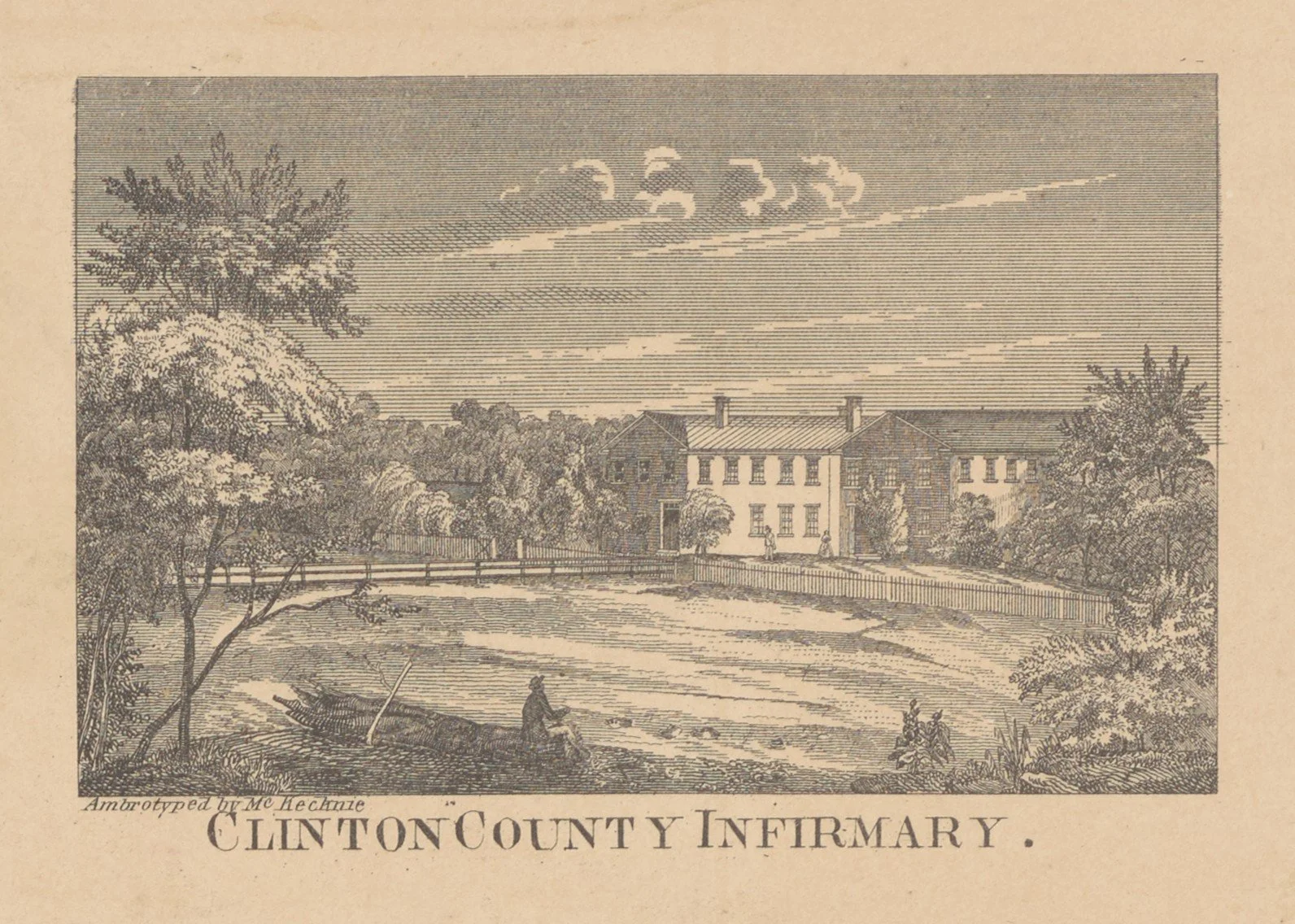
Clinton County Infirmary, circa 1858 (earliest known view): Traced from an ambrotype — a photograph on glass made on or near the grounds — so it records the building as it actually stood rather than as an artist imagined it. From Henry Francis Walling’s Map of Clinton County, Ohio (1859); ambrotype credited to McHecknie. New York Public Library, Lionel Pincus and Princess Firyal Map Division (Map Div. 17-5066); public domain.
Lorenzo “Cap” Williams had lived inside the Clinton County Infirmary for most of his life. He arrived in December 1862 — the second year of the Civil War — and by the late spring of 1927 had spent more than 64 years within its walls. He came as a young man with crippled hands, to the county’s only shelter for those who could not provide for themselves. He was not alone. A journalist that spring named others — men and women whose world had narrowed to a single building a mile east of Wilmington, Ohio.
By then the building was failing — fast, and from neglected upkeep more than age. State inspectors had declared it unsanitary and unsafe. A state official called it one of Ohio’s most deplorable county homes; the superintendent warned a strong wind might bring it down. The county had tried twice to pass a bond for a new building. Both times the votes fell short.
Williams and the others lived in the present, inside the old building — the one the state said should not stand. The replacement had been promised. It had not arrived. They had nowhere else to go. Williams died on January 14, 1928 — seven months after the journalist’s visit. He was buried at Sugar Grove Cemetery, in the charity section, without a headstone. The county had moved its burials off the farm more than 25 years before. For those in the charity lot, the arrangement was the same.
Across Lytle Creek, in a field the Board of Directors called the “burying ground,” at least 250 men, women and children were laid to rest without headstones or recorded grave locations between 1840 and 1903. Wilmington had no public cemetery until 1857; the poor were buried at the farm. Yet the record held what it could — every name and date, the burying ground for some, the rest established only by exhaustive later research. It never fixed the place of a single grave. For decades the community that cared for the living kept faith with the dead. The Obscure Lot was not lost to forgetting; it was lost to the land, remade in the war years and after, until nothing aboveground marked it.
It was lost to the land.
That ground, and the people in it, are the subject of The Obscure Lot, the book I’m developing with archival support from the Clinton County History Center. It builds on a foundation laid by Clinton County Genealogical Society volunteers who began transcribing infirmary records in 2011.
Three Names, One Institution
The farm on Fife Avenue carried three distinct names across 154 years — each reflecting a shift in how the county understood its responsibility to those with nowhere else to go.
The Clinton County Poor House was established in 1835, formally organized on March 11, 1836 under an Ohio law authorizing counties to house their poor. It was built around a working farm. Residents contributed labor — field work, kitchen duties, daily operations — in exchange for shelter, clothing and provisions. James Wilson, the first superintendent, managed both the farm and those who lived on it.
“Infirmary” was codified in Ohio statute in 1853, but a federal census enumerator had already applied that name to the institution in August 1850 — three years before the legislature caught up. The shift reflected a more humanitarian model of care — one that acknowledged residents not only as laborers but as people who needed treatment, not just work.
The third shift came in the early 1920s. Officials began adopting “County Home” — an effort to shed what they called the humiliation of the word “Infirmary.” A new fireproof building dedicated in 1929 marked the change in spirit, but not yet in law. The formal renaming waited: with the Clinton County Children’s Home in operation, “County Home” meant two different things. When the Children’s Home closed in 1981, that obstacle fell away, and in June 1985 the commissioners made it official — “infirmary” was derogatory, a commissioner said, and “home” would no longer mean two things.
Two Buildings
Two structures served the institution. The first, completed in 1836 and expanded over the decades, was a two-story brick building on a farm that grew to 368 acres. It was prominent enough that when Henry Francis Walling mapped the county in 1859, his engravers illustrated only six of its buildings — the courthouse, the fairgrounds, three of its finest homes and the infirmary. The refuge for the poor stood among the county’s showpieces.
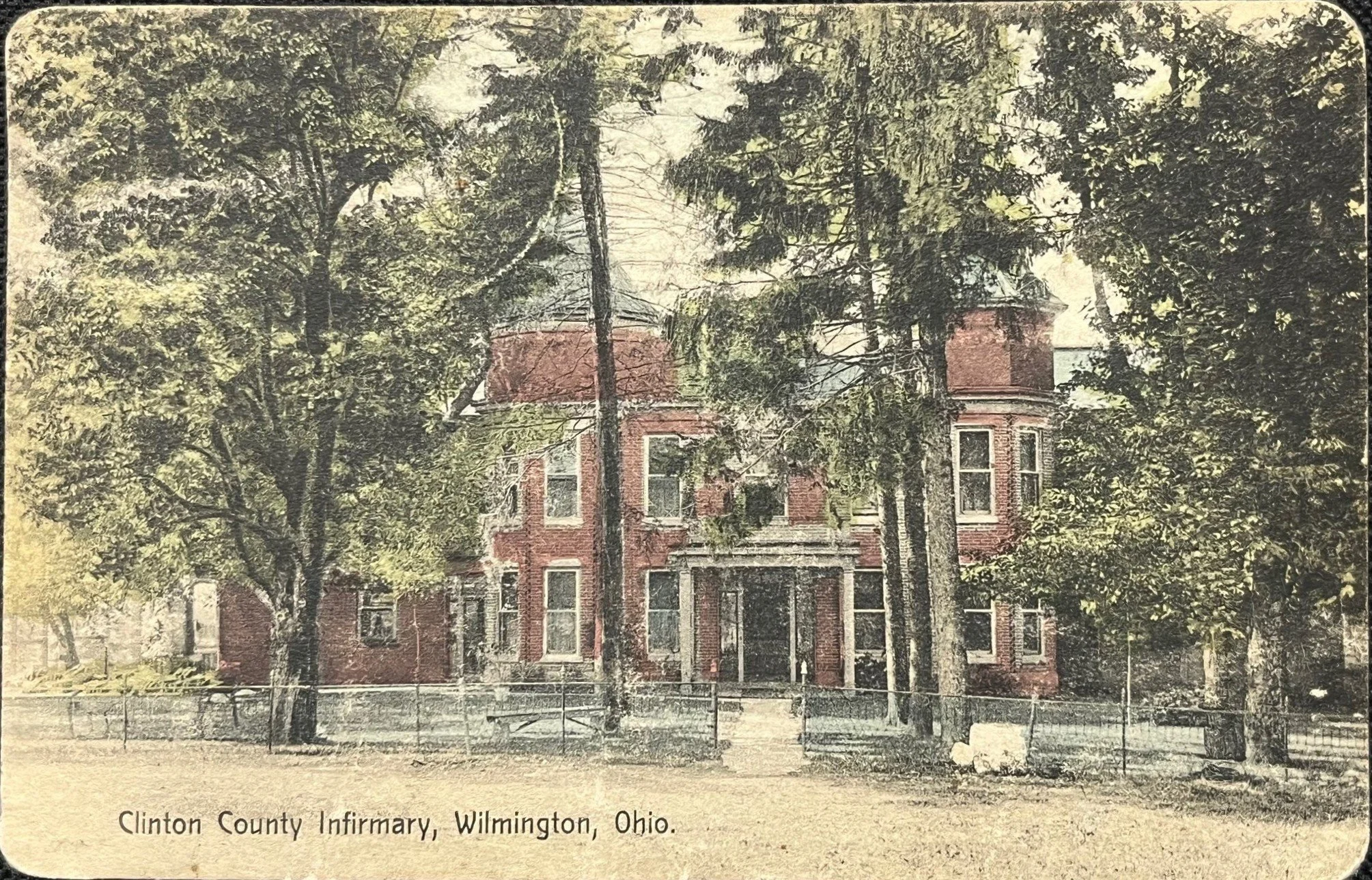
Clinton County Infirmary, circa 1909 (original building): The first infirmary building on Fife Avenue — known locally as “the pokey” or “Seven Gables” for its tin-covered roof and slate-shingled cupolas. In April 1965, county commissioners, the county engineer and county employees watched as it was put to the torch; the Wilmington News Journal reported the fire ran five hours, and officials noted the cleared site would allow expansion of the nearby county highway garage. Postcard, circa 1909. Clinton Co. Ohio Genealogy Group.
After two failed bond votes, the county secured approval for a replacement in November 1927. The second building — completed in 1929 on a $105,000 bond and designed by Robert S. Harsh, Ohio’s former state architect — is the one that survives; the original brick building stayed in farm use until county officials put it to the torch in April 1965. The Ohio Division of Charities called the one-story, four-wing fireproof structure the “ideal type” of county home facility at its dedication. The County Home operated there until the county closed it in 1989; Wilmington College purchased the building in 1997. Most Clinton County residents know it today as Fife Hall.
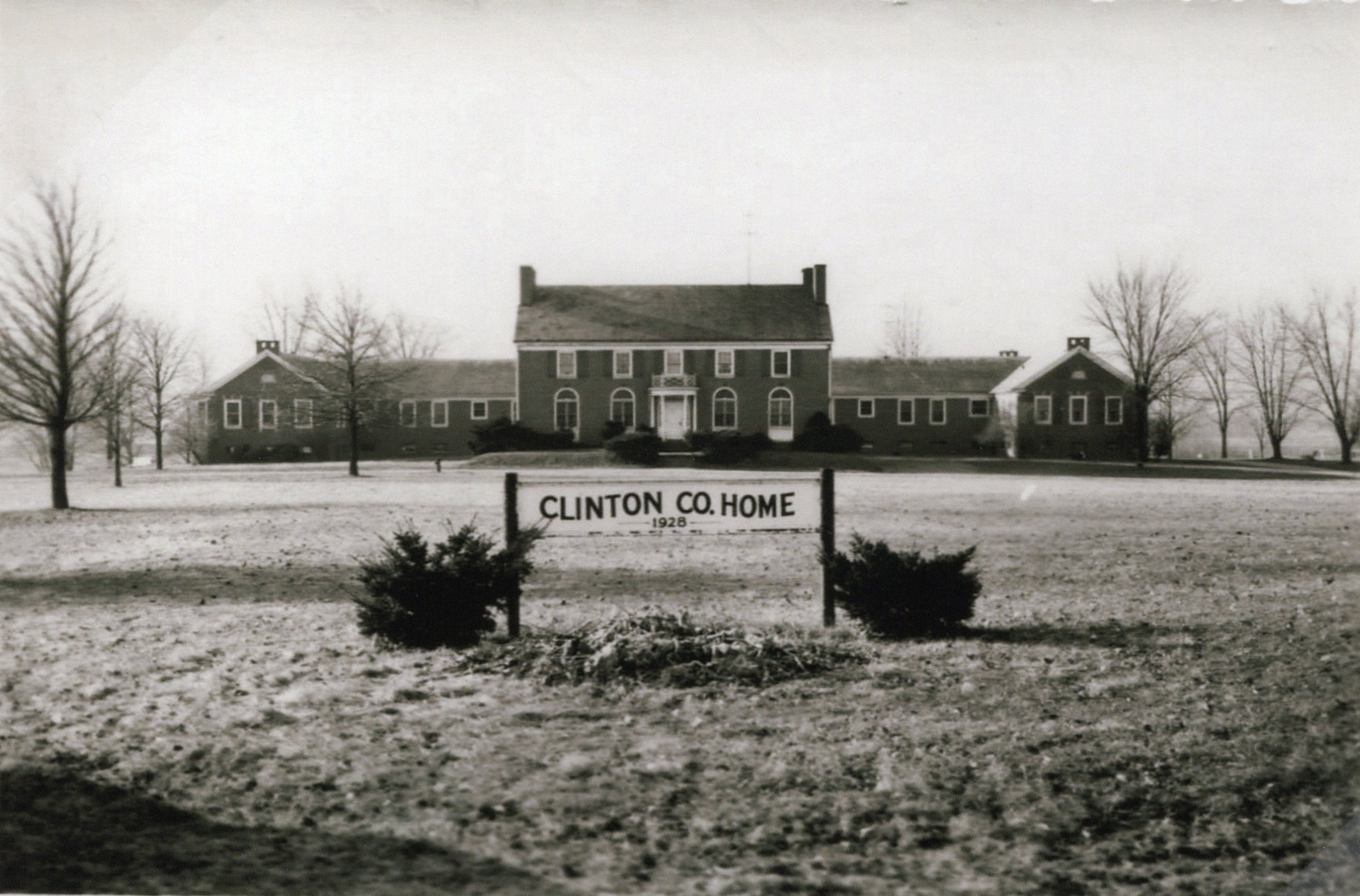
Clinton County Home, circa 1929 (surviving building, now Fife Hall): The County Home sign visible in the foreground places this photograph at or just after the 1929 dedication. Built at a per-bed cost of about $700 — roughly a third of the per-bed cost at comparable county facilities built after World War I — the building gave each residential wing a hospital ward that could be isolated, reflecting the era’s concern with tuberculosis among the aged and poor. Photograph from Clinton County Infirmary Memories by Eva Wallace Vanniman Botts; courtesy of the Clinton County History Center.
The people buried in the Obscure Lot never lived in that second building. They died under the first two names — in the first building, or on the land around it. The new building was still more than two decades away when burials on the farm ceased.
Two Lives From the Obscure Lot
Eliza Chenoweth (ca. 1812–1851) was already failing when Clinton County took her in. On September 16, 1851, the trustees of Clark Township examined her and found her “in a destitute state,” “without the means of support” and “in a state of partial derangement.” She was admitted three days later. Nineteen days after that — at 21 minutes past 6 o’clock on the evening of October 8 — she died of typhus fever, 39 years old, a native of Frederick County, Virginia. Her record sits on a page headed “Poor House Records” whose entries already say “Infirmary” — the county’s language shifting around her as she died. The following January, the directors paid $2 for her transport from Clark Township; in March, the Clinton Republican named her in the infirmary’s annual accounting, one of only two deaths among 36 residents that year. The county recorded the minute she died and the cost of her last journey. It never wrote down where she was buried — in 1851, it didn’t need to.
Mary McKinney (d. 1902) knew the infirmary the way many of its residents did — not as a place she was carried to at the end, but as a shelter she returned to again and again. First admitted from Green Township on January 22, 1892, she left and came back several times over the decade that followed. The 1900 census found her there: widowed, born in Ohio, unable to read or write — and the mother of one child, still living. Her age was recorded differently nearly every time someone wrote it down: 60 at her admission, 73 in the census eight years later. She returned a final time and died on May 14, 1902 — eleven weeks before the directors resolved to send future burials to Sugar Grove Cemetery. Reporting the change, the Clinton Republican called the field where she lay “an obscure lot on the Infirmary grounds” — the earliest known use of the phrase in print, and the name the book carries. Her grave, like nearly all of them, has no recorded location.
Over six decades, the Obscure Lot received the remains of at least 250 people the county had sheltered. Earlier in this investigation I profiled four of them — Walter Roberts, George Wright, Harley L. Welch and Margaret Black. From 1835 to its final closure in 1989, the institution touched nearly 3,000 lives. The Obscure Lot will tell their stories.
If your family’s trail has gone cold, it starts here: www.thegraveguy.com/grave-survey

