
Two Leading Quakers Crossed a Creek to Bury a Poor Man with Grace

The Doan House, 822 Fife Avenue, Wilmington, Ohio — built in 1840 by James Wilson, the first superintendent of the Clinton County Infirmary, and later home to Judge Azariah W. Doan. Listed on the National Register of Historic Places and now owned by Wilmington College, the house stands about three-quarters of a mile from the Obscure Lot, where Judge Doan and Joseph Wright saw that Harley L. Welch was not committed to the earth in silence. Photo: National Register of Historic Places nomination, 1978/1979.
In the spring of 1900, two of Clinton County’s most prominent men made their way to a grave on the county infirmary farm near Wilmington, Ohio. They crossed Lytle Creek — which separated the infirmary from the orchard and fields beyond — to bury a man who had died with nothing. One was a Civil War general, 75 years old, who had become a respected judge. The other, 87, was the oldest Quaker minister in the region.
They went anyway.
That grave lay in what a period newspaper called the “obscure lot” — the lost burial ground of the Clinton County Infirmary, where at least 250 men, women and children were laid to rest without headstones or recorded grave locations between 1840 and 1903. For more than a century, their names existed only in institutional registers and the transcription work that Clinton County Genealogical Society volunteers began in 2011.
That foundation grew into the forensic investigation I carry today — the one that pushed me to go professional — and its findings are becoming a book, The Obscure Lot. On the county side, the Board of Commissioners’ geophysical survey of the site has been completed — its technical report is pending delivery — and a commemorative ceremony was held at the Obscure Lot during the Independence Day period, with formal dedication and preservation planning underway.
A Faith That Would Not Stay Home
What sent two of the county’s leading citizens to the grave of a man Wilmington had long since left behind was, in large part, a shared faith. Wilmington and the surrounding county were built by the Society of Friends — the Quakers — and that heritage runs through this story from beginning to end.
Judge Azariah W. Doan was born in 1824 into one of Wilmington’s founding Quaker families. He set aside the pacifism of his heritage to volunteer for the Civil War in 1861, rose to colonel of the 79th Ohio Volunteer Infantry and was brevetted brigadier general for bravery in the field. After the war he served 15 years as a Common Pleas judge, known for tempering justice with mercy. He returned to the Friends Church and remained a devoted member for the rest of his life.
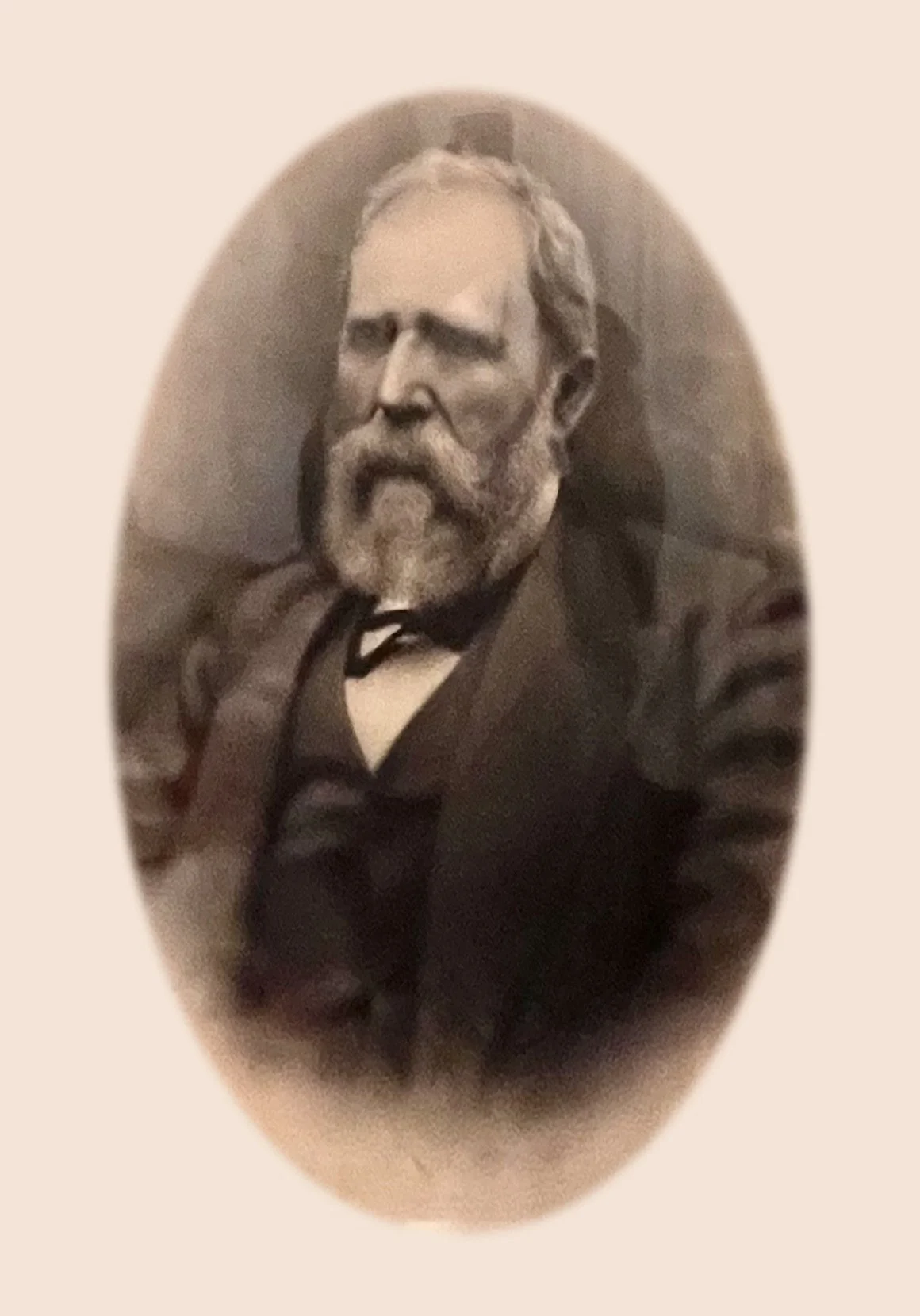
Judge Azariah W. Doan (1824–1911), in a charcoal portrait by Eli Harvey, the internationally known sculptor born to a Quaker family in Clinton County, Ohio. When President Lincoln called for troops in 1861, Doan helped raise Company B, 12th Ohio Volunteer Infantry, the first company offered to the state in response. As a judge he never charged legal fees to soldiers or their widows, and is said to have loaned out money until he nearly lost his own home. He was inducted into the Ohio Veterans Hall of Fame in 2010, nearly a century after his death. Portrait by Eli Harvey; courtesy of Jeff Thomas, great-great-grandson of Judge Doan.
Joseph Wright had come to the faith by a steadier road. He was the oldest minister in the Wilmington Yearly Meeting of Friends, a recorded minister for nearly 40 years and one of the founders of Wilmington College. Orphaned young and raised by a Quaker family, he became a lifelong abolitionist and a tireless temperance reformer. By 1898, he had attended every Wilmington College commencement since it was founded — beginning with 1875, when his daughter Ellen crossed the stage as one of four graduates.
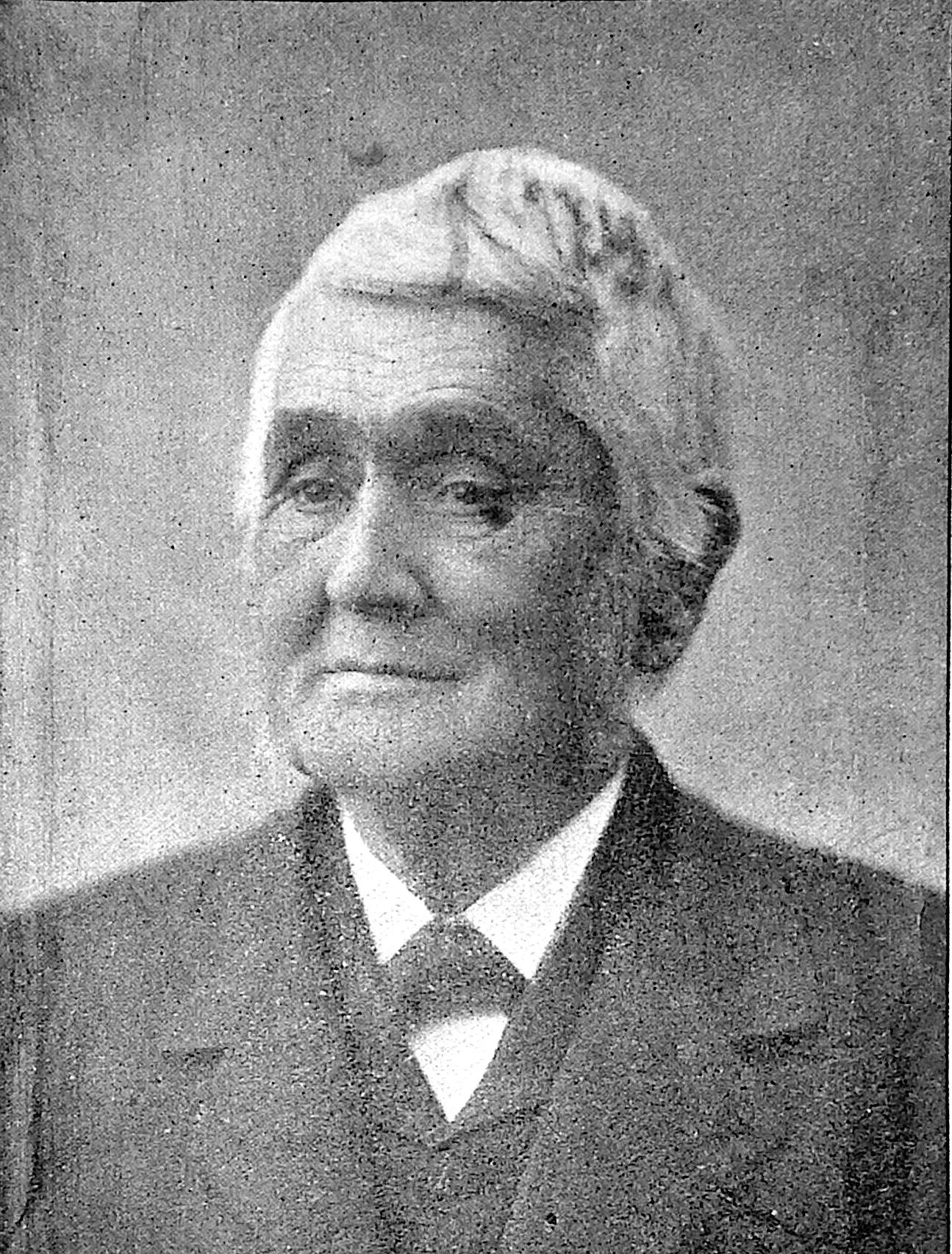
The Rev. Joseph Wright (1812–1907), recorded minister of the Society of Friends for nearly 40 years. In 1892, Wright called the inaugural Wilmington Yearly Meeting of Friends to order as the oldest minister present. He died in November 1907 at 94. Photo: The American Friend, vol. 5 (Second month, 1898), p. 174. Clipping held in the Earlham College Friends Collection, EC-16.8 XVI, Box 3, Folder 96, Richmond, Indiana.
The community had been ministering to the infirmary’s residents long before that spring day. The Women’s Christian Temperance Union, working in close partnership with the region’s Quaker congregations, maintained a dedicated infirmary department among its 16 active programs, with members arriving on regular visits carrying bouquets tied with white ribbons. Quaker families had served the institution across generations — as directors, administrators and caretakers. Records document gatherings — religious services and community visits — of as many as 54 residents at once. What Doan and Wright did that spring was not singular. It was the expression of a ministry their community had built over decades.
These were not distant figures — they lived just six doors apart on Fife Avenue. When a fallen lawyer named Harley Welch died at the infirmary in 1900, they went to see that he was not committed to the earth in silence.
The thread connecting that moment to the present is not hard to find. Wilmington College — which Wright helped found and Doan helped purchase at auction in 1870 — is still open and active today. The house Doan lived in on Fife Avenue — built in 1840 by the infirmary’s first superintendent — now belongs to the college, as does Fife Hall, the second infirmary building itself. Wilmington College, the Doan house and Fife Hall all stand within sight of the ground where two of the county’s most prominent men buried a man who had outlived his place in it.
Two Lives From the Obscure Lot
Among the confirmed burials in the Obscure Lot, two residents illustrate the range of people the institution absorbed — and the community it quietly reflected.
Harley L. Welch (1809–1900) studied law in the office of a sitting judge and moved in Wilmington’s professional circles — described by the Wilmington Journal as “of a bright mind and gifted of speech.” But a long struggle with drink gradually wore away what talent had built. Over the years he slipped from prominence into hardship, and finally into the Infirmary, where he died on May 4, 1900, at 91. He was buried in the Obscure Lot. The two men who came to bury him were Judge Doan, his old friend, and Joseph Wright, the minister Doan summoned to perform the service. For Welch, it was a final acknowledgment from the world he had once inhabited.
Margaret Black (ca. 1816–1882) arrived at the county Poor House on January 29, 1846, from Vernon Township — destitute, without friends or place to go, with two young children in tow. She would spend the next 36 years within those walls, sweeping the pavements and hauling in bushels of beans from the field each autumn. In April 1881, her story reached the local papers when Superintendent J.N. Stephens wrote to the Wilmington Journal to report what he called a remarkable case: Margaret Black, entirely blind for three years, had suddenly regained her sight. The paper described her as 75. The Journal called it a “second sight.” The county called it a wonder. She died at the Infirmary on May 26, 1882 and was buried in the Obscure Lot — 20 years before the Directors passed their 1902 resolution ending all burials on the farm. No marker survives.
These two lives — the fallen lawyer and the resilient Poor House mother — ended in the same fenced acreage, a generation apart. They are two among at least 250 people buried in the Obscure Lot. Earlier in this investigation I profiled two veterans documented among the burials: Walter Roberts, a Revolutionary War soldier from Maryland, and George Wright, an Irish immigrant who served in the War of 1812, lived to 98 and voted for George Washington twice. From 1835 to 1989, the institution touched nearly 3,000 lives. The Obscure Lot works to return names and stories to as many of them as the records preserve — the veterans, the laborers and the children time nearly erased — brought back, one by one, from silence.
If your family’s trail has gone cold, it starts here: www.thegraveguy.com/grave-survey

