
Clinton County, Ohio, Civil War Soldier, Lost Among the Unknown Since 1864, Receives VA Memorial Marker
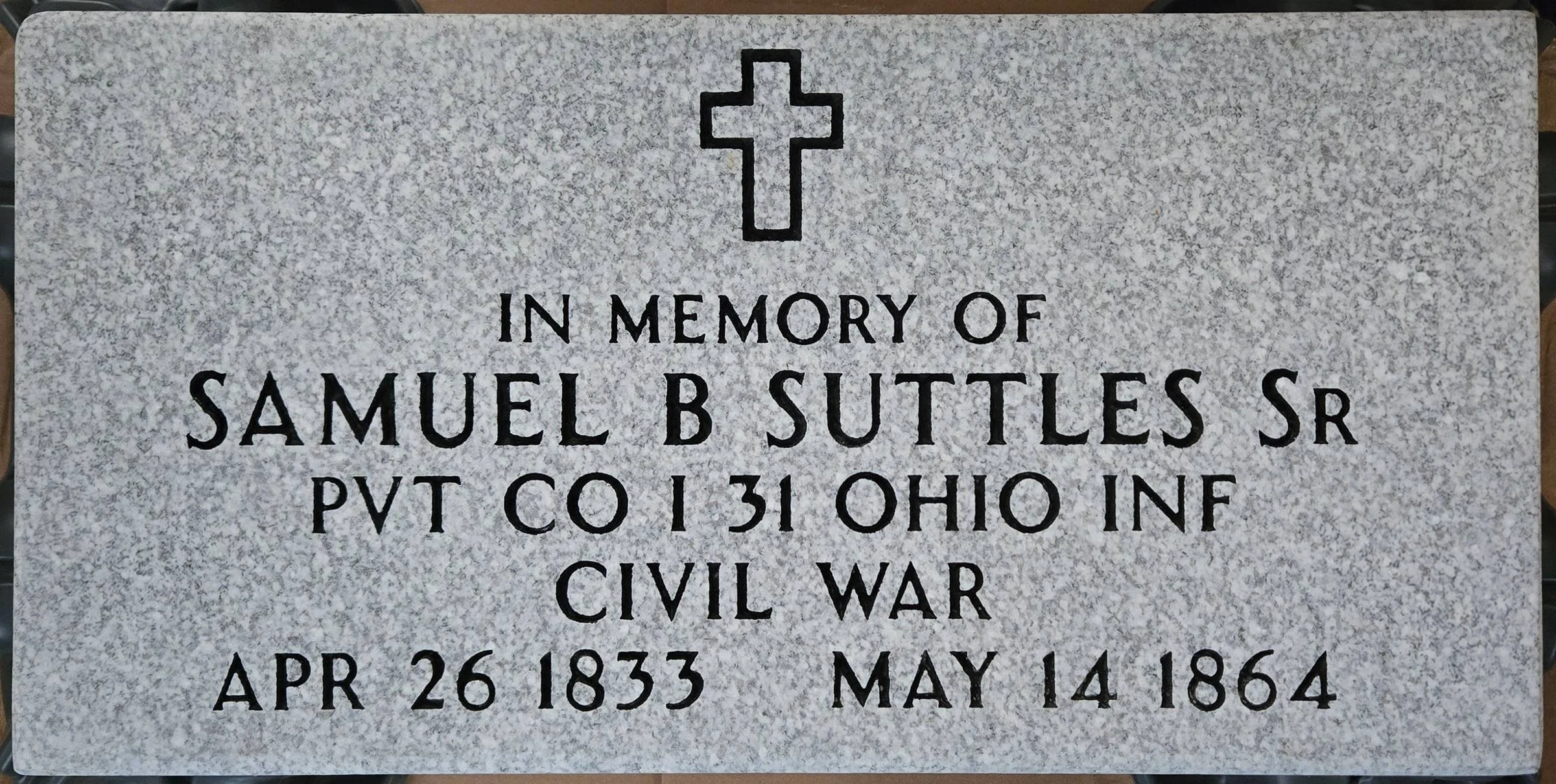
The flat granite memorial marker for Pvt. Samuel B. Suttles Sr., issued by the U.S. Department of Veterans Affairs on the family’s application (VA Form 40-1330). The VA provides “In Memory Of” markers for veterans whose remains lie in a grave that cannot be located or identified. Author’s photo.
Before he was a soldier, Samuel B. Suttles Sr. made barrels. Through the 1850s the Clinton County, Ohio, cooper turned out whiskey barrels by the hundreds and loaded them onto rail cars at Clarksville, Ohio. In February 1864, with the Civil War in its fourth year, he set the trade aside and enlisted in the 31st Ohio. Within three months he was dead — killed in the bloody fighting at Resaca, in the pine-wooded foothills of northern Georgia. He was 31. His body was never identified, and for more than 160 years no stone anywhere carried his name.
That has changed. The U.S. Department of Veterans Affairs has issued a flat granite memorial marker in his honor, bound for the family’s plot at Milledgeville-Plymouth Cemetery in Fayette County, Ohio — the result of my years of forensic research as his 3rd-great-grandson.
The Cooper of Company I
Samuel B. Suttles was born April 26, 1833, in Muskingum County, Ohio, and by early adulthood had made his home in Clinton County. There he married Elizabeth Ann Mills on April 22, 1852, and took up the cooper’s trade — work he did with evident pride. When a contract dispute between his Clarksville employer and a Fayette County customer reached that county’s common pleas court, Suttles testified to the quality of the whiskey barrels he built — tight and merchantable, 14 and 16 hoops to the cask. He could pick his own out of a full shop: “Every cooper has his block mark,” he swore in the 1858 deposition — “a mark on the head made with the adze.” The buyer’s lone complaint, he recalled, was that he could not turn them out fast enough.
On February 26, 1864, Suttles enlisted at Hillsboro, in neighboring Highland County, Ohio, joining Company I of the 31st Ohio Volunteer Infantry as a private and signing his enlistment papers with his mark — an X. That spring the regiment moved south with Maj. Gen. William T. Sherman’s advance on Atlanta, Georgia. Suttles was killed on May 14, 1864, at Resaca. Filing for a widow’s pension in 1866, Elizabeth Suttles swore that her husband had been “shot through the head with a musket ball and instantly killed” in the line of duty. He left Elizabeth and three young children.
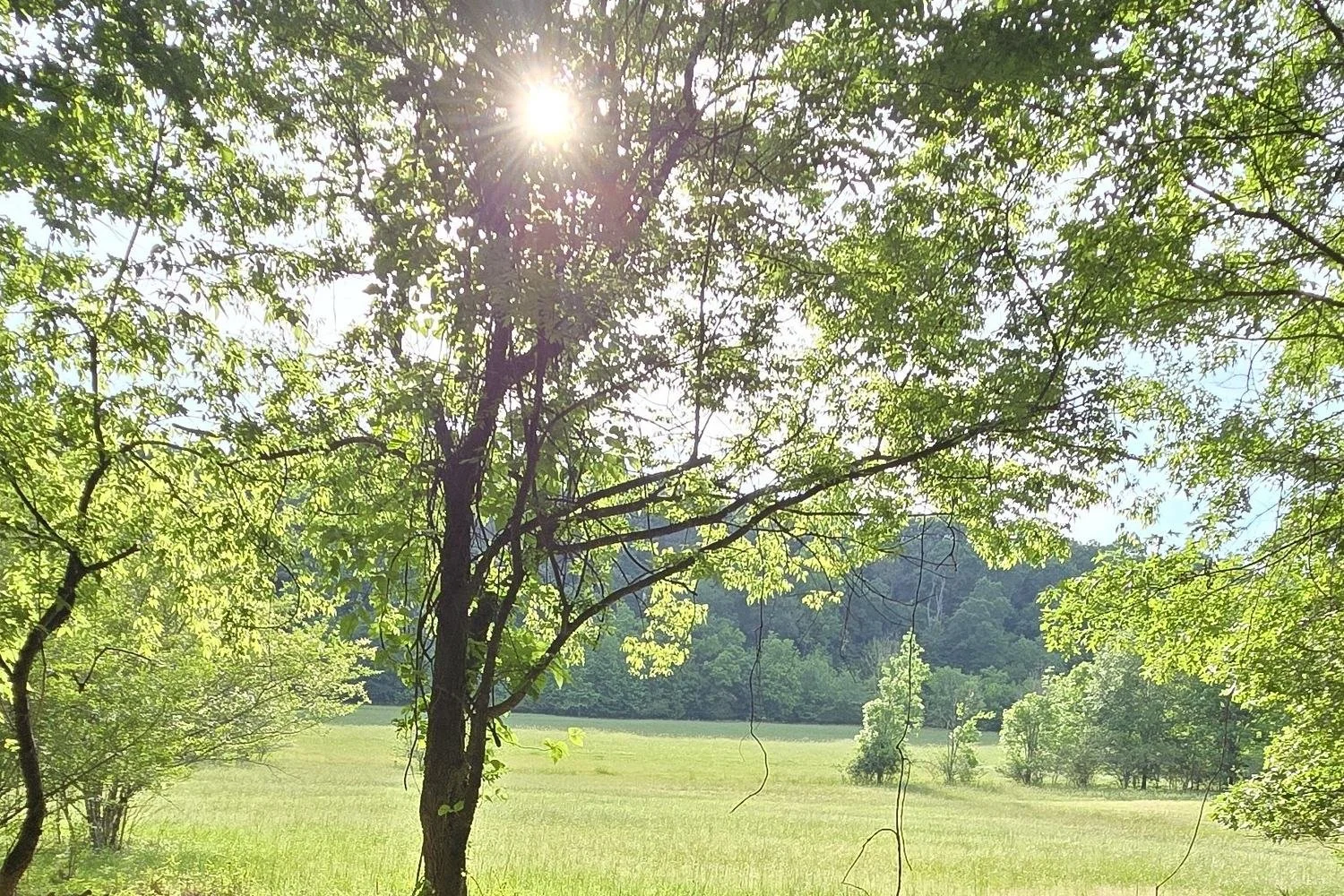
The 103rd Ohio Volunteer Infantry marker at Resaca Battlefield Historic Site stands at the high-water mark of the Union assault of May 14, 1864 — the day Suttles was killed — at the foot of the Confederate ridge. The view looks west toward Snake Creek Gap and the route of the Union advance; the site lies within about 100 yards of where my field research places the 31st Ohio’s line and the ground where my ancestor fell. Author’s photo.
The Search at Chattanooga
What became of Suttles’ body is where the record turns uncertain — and where the research grew hardest. In 1866 the U.S. Army disinterred the Union dead from Resaca and battlefields across the region and reburied them at Chattanooga National Cemetery in Tennessee. An 1874 inspection counted 12,928 interments there, 4,860 of them unknown — section upon section of graves, some marked only “Unknown,” others with no marker at all.
Ohio’s official roster of Civil War soldiers records Suttles as buried at Chattanooga, yet the cemetery’s own registers do not list him by name. Like hundreds of others brought from Resaca, he appears to lie among the unknowns; my research points to Section L, though no individual grave can be identified.
Because the remains cannot be pinpointed, the stone is a memorial marker rather than a headstone over a located grave. I drove to Chattanooga in May 2025 — arriving on the 161st anniversary of Samuel’s death — to make my case in person to Michael Faust, who directs the Chattanooga and Nashville, Tennessee, national cemeteries. After hearing the family’s story, Faust helped guide the application through.
Establishing even that much took years and a great deal of paper. Working from federal service and pension files, muster rolls, the Official Records of the war, county court and marriage records, and the Army’s own reinterment ledgers, I rebuilt the case one document at a time. As a registered researcher at the National Archives, the Ohio History Center, and the Tennessee State Library and Archives, I can request records unavailable through commercial genealogy sites. Handwritten-text recognition software driven by artificial intelligence helps me read ledgers no search engine can. The records rarely hand you a soldier. You build him back from a hundred smaller proofs.
Four Generations Without a Stone
The family scattered in the years after his death. Two of Samuel’s boys were taken in at the Clinton County Infirmary and sent out to work. Daniel — my 2nd-great-grandfather — lived with his mother until she remarried, then passed into guardianship in Greene County, Ohio. Elizabeth’s own death and resting place remain unknown.
For me, the search reached back through my own family. Suttles’ father, William Suttles — my 4th-great-grandfather — lies in an unmarked grave among at least 250 burials at the Clinton County Infirmary, the lost cemetery I call the Obscure Lot and the subject of my forthcoming book of the same name.
Suttles’ son Daniel lies somewhere in Evans Cemetery on Snowhill Road — the exact spot unknown. The township trustees told me its burial records were “lost in a fire.” A trustee and a township worker have also told me the cemetery is to close after one final burial. For now I have set two temporary markers, for Daniel and his wife, Mary, near where I believe they rest.
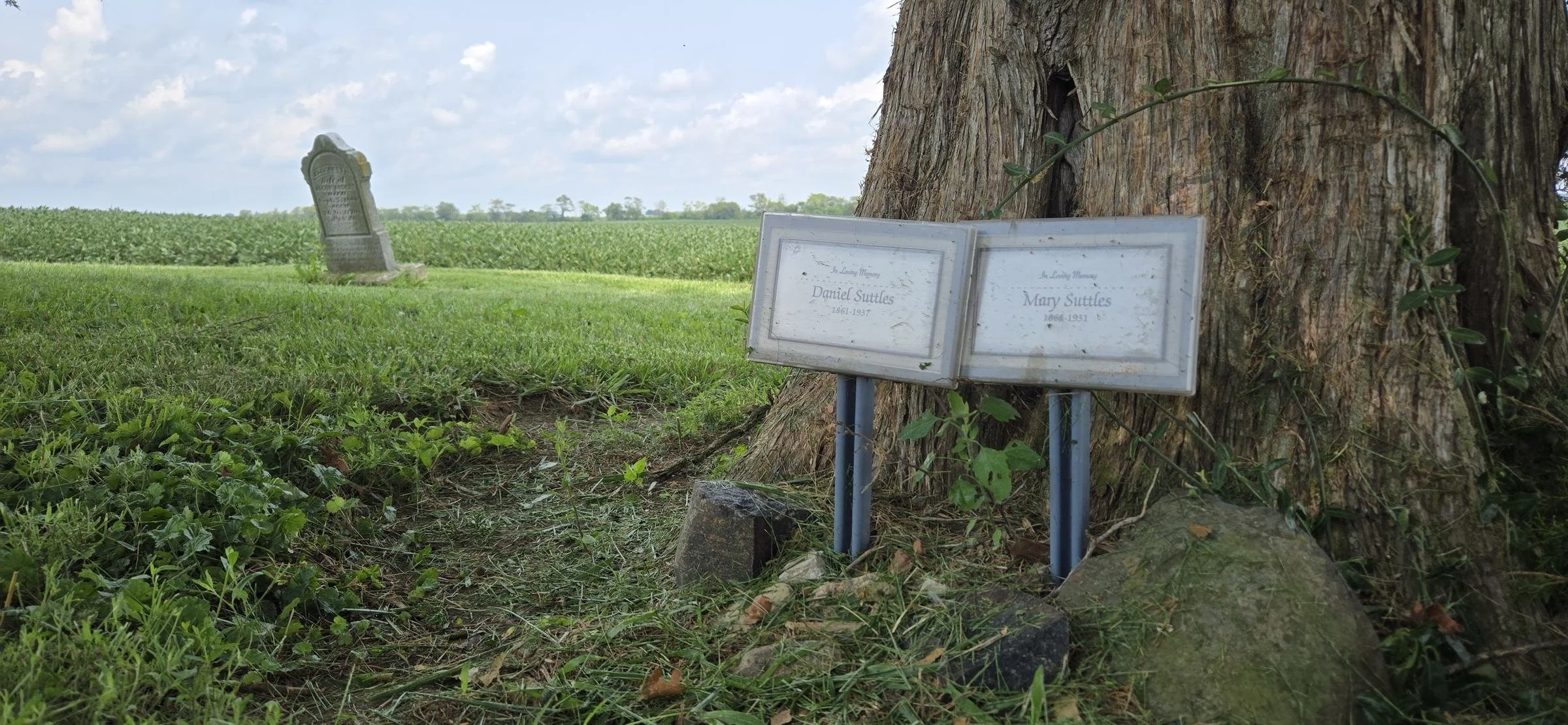
The unfinished work: temporary markers for Daniel Suttles (1861-1937) and his wife, Mary (1861-1931), beneath an old tree at the edge of Evans Cemetery — the birth year on Mary’s was corrected by research finished after the markers were made. Among the 171 memorials Find a Grave lists here, the earliest for a death in 1831, is one for Judge Stephen Evans. The 1882 county history gives his death as May 14, 1879 — 15 years to the day after Suttles fell at Resaca. The 1980 county cemetery book prints May 11, but the age at death it records, 76 years, 1 month and 18 days, counts back to the birth date the history gives him, March 27, 1803, only from May 14. Author’s photo.
Daniel’s son Orla lay unmarked at Milledgeville-Plymouth Cemetery until I set his stone. Four generations of this family went into the ground without a name over them. Samuel’s name is one I could finally set in stone.
On the family plot of my grandmother, Christina Louise (Suttles) Groves — Samuel’s great-granddaughter — in the same cemetery where Orla rests, the memorial will be set into the ground at the foot of her grave. I will place it myself, using the same marker-setting practices I bring to my preservation work. The family has also honored Suttles in a form fitting for a man who spent his working life at the cooper’s bench: a wall tribute crafted from a bourbon-barrel stave by Columbus Barrel Co., carrying the words “Muskingum to Clinton County, Ohio.”
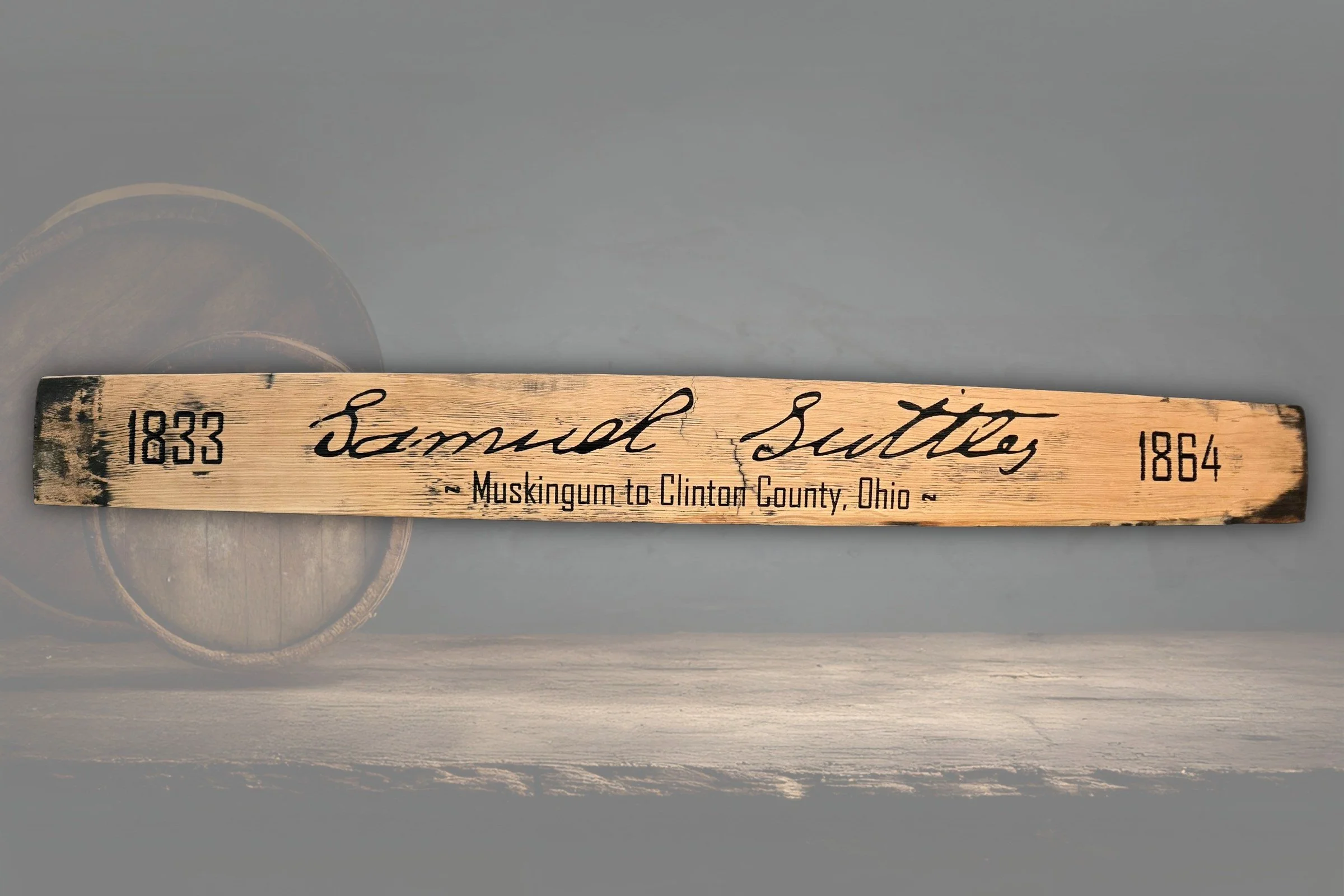
The family’s private tribute to Samuel B. Suttles: a bourbon-barrel stave carrying his name and the years 1833 to 1864, a keepsake for the home to accompany the government memorial bound for the family plot. One memorial the government provides; the other the family made. Author’s photo.
If your family’s trail has gone cold, it starts here: www.thegraveguy.com/grave-survey

