
A Strand of Hair, Sixty-Two Cousins: What DNA Can and Can’t Settle
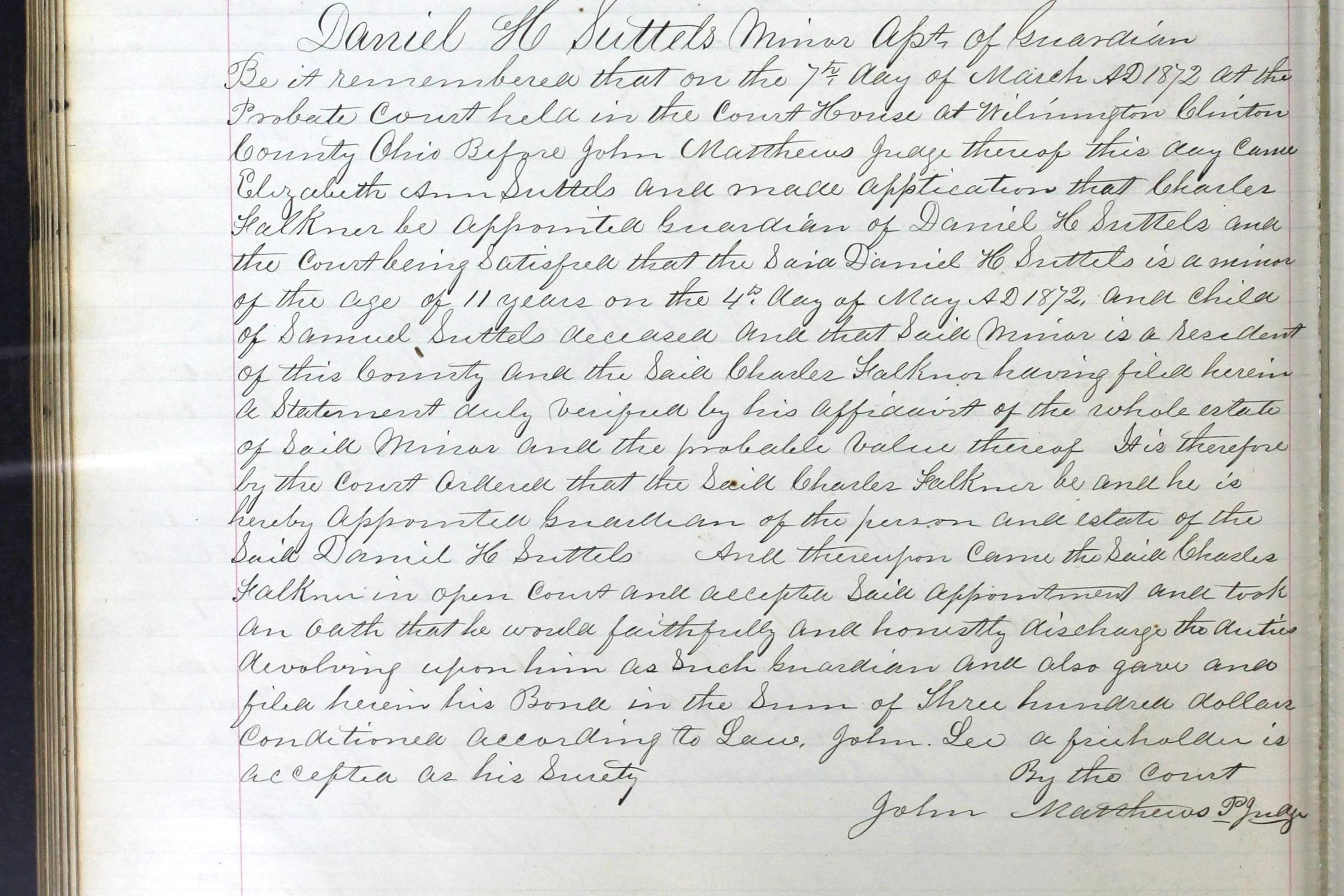
Appointment of a guardian for Daniel H. Suttels, “child of Samuel Suttels deceased,” Clinton County, Ohio, Probate Court, March 7, 1872, page 596.
On September 22, a Smithsonian-led team announced that DNA recovered from Thomas Jefferson’s hair adds new weight to one of the oldest questions in American history: whether he fathered children with Sally Hemings, a woman he enslaved.
The work is careful, and it is worth understanding what it did and did not do. The hair that first seemed promising, strands found in Jefferson’s Bible, turned out not to be his. The DNA came instead from a packet of hair at Monticello. The researchers confirmed it was Jefferson’s, then measured how much DNA he shares with known and possible descendants, including descendants of Hemings’ sons Madison and Eston. Their conclusion, in a preprint posted September 21, is that the amount of shared DNA is “more likely under the model of direct Thomas Jefferson paternity than other proposed scenarios.” TheGrio reported the result as a 99.9 percent chance that Jefferson fathered a child with Hemings.
Two cautions travel with that result. The paper has not finished peer review; a book about the search came out first. And one Hemings descendant withdrew her DNA sample, objecting to that order of events. The researchers say removing her data did not materially change the finding. Both points matter. DNA is evidence about people, and some of those people are alive.
The Same Method on a Family Tree
What struck me most is the method. Measuring how much DNA two people share, and asking which family tree best explains it, is what consumer DNA tests do for the rest of us. On AncestryDNA, a tool called ThruLines takes my DNA matches, looks at the family trees they have built, and suggests which ancestors connect us. It is a hypothesis generator. It is not proof. I have used it three ways.
A missing father. My second great-grandmother, Mary Belle Chaney, was born in 1861 and carried her mother’s surname. The records gave me her mother, Harriet Chaney, and no father. DNA gave me one. ThruLines now lists 62 DNA matches who descend from a man named Solomon Sharp (1836–1913). Thirty-six of them come through Mary Belle, as I do. The other 26 come through five of Sharp’s later children, Mary Belle’s half-siblings, whose families had no reason to know she existed. No single match proves anything. Twenty-six cousins on separate branches, all sharing DNA with me, is a pattern the paper trail alone could never have produced.
A father who never came home. My third great-grandfather, Pvt. Samuel B. Suttles of Company I, 31st Ohio Volunteer Infantry, was killed at Resaca, Georgia, on May 14, 1864. ThruLines connected me to cousins through him, but the family only came into focus when I pulled his Civil War records and the guardianship files opened for his children in Clinton and Greene counties, Ohio. On March 7, 1872, the Clinton County probate court appointed a guardian for “Daniel H Suttels,” age 11, “child of Samuel Suttels deceased.” That line tied Daniel, my second great-grandfather, to the soldier, and the files around it led me to branches of the family I had never heard of. Here the DNA pointed and the courthouse confirmed.
Children placed away. Some relatives were never in the trees at all. Half-siblings in my grandparents’ generation were adopted out as children, and their families knew little or nothing of each other. DNA matches with unfamiliar surnames were the first sign. County and state adoption records, and the records of a children’s home placement agency, told me who they were. Because their children and grandchildren are living, I am not naming them here.
Where DNA Stops and Records Begin
That is the pattern I trust. DNA is extraordinary at telling you where to look. It is weaker at telling you what happened, and it cannot tell you why. The Jefferson team did not rest on shared DNA alone; they tied the hair to a documented collection and weighed their numbers against the other men who could have been the father. At a smaller scale, that is the job every time a tool like ThruLines puts a stranger in your tree: find the record that makes the hypothesis a fact, or leave it a hypothesis.
It is also why I name some people and not others. The dead of 150 years ago belong to history. Their grandchildren’s privacy does not.
If ThruLines has handed you a name you can’t explain, start with the records it points to, not the tree it came from. And if you are researching a line in Clinton, Greene or Highland County and want a second set of eyes, I would like to hear from you.
Sources: Richard E. Green et al., “The DNA legacy of Thomas Jefferson,” bioRxiv preprint, posted September 21, 2026, doi:10.64898/2026.09.18.752809; NPR, September 22, 2026; TheGrio, September 23, 2026. Clinton County, Ohio, Probate Court, March 7, 1872, p. 596. ThruLines figures as displayed in the author’s AncestryDNA account, September 28, 2026.

