
The Infirmary Director Who Refused to Let Its Poor Vanish
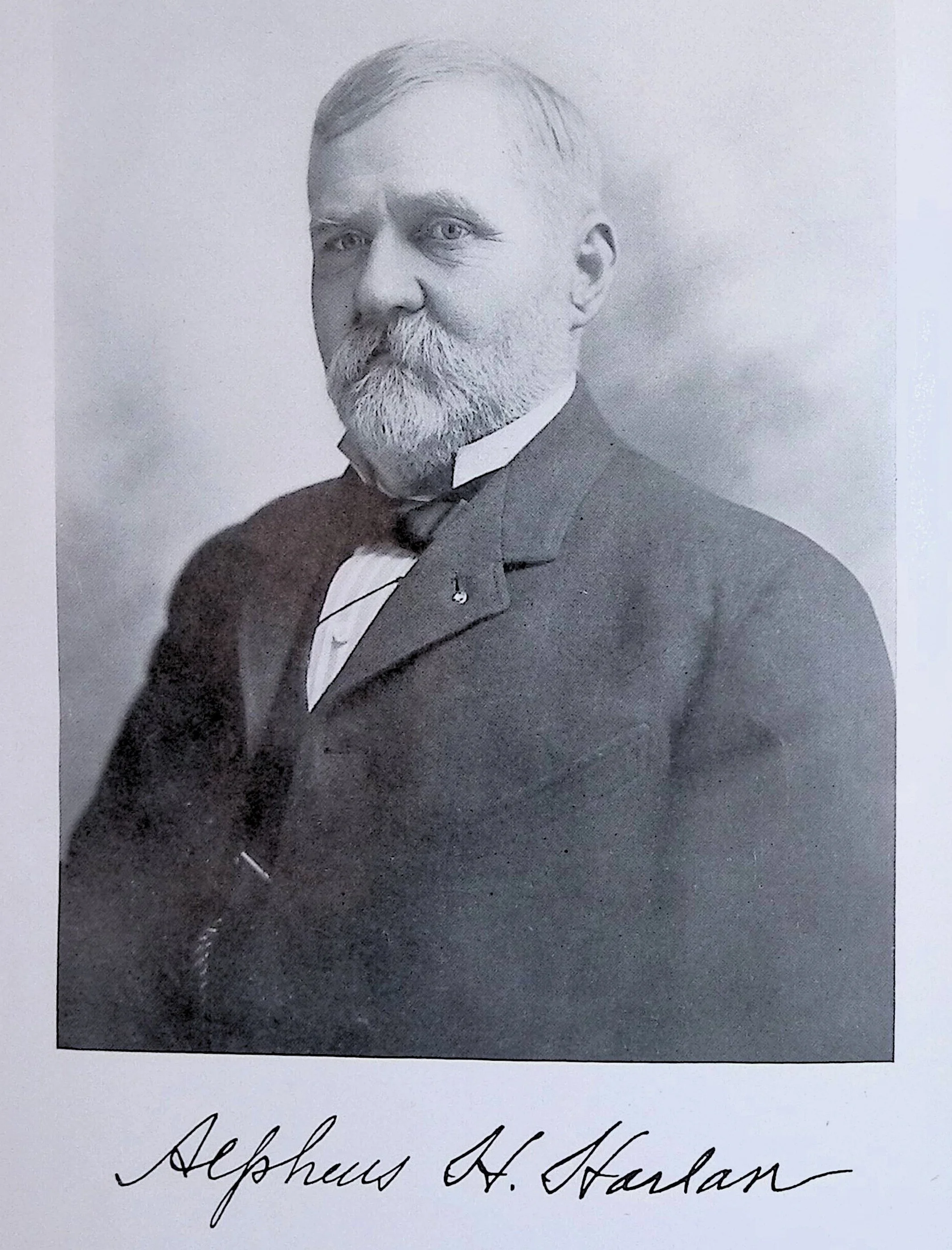
Beyond his service on the infirmary board, Harlan (1848–1919) held a string of New Burlington offices: justice of the peace for Chester Township — the post that earned him the nickname “Squire Harlan” — and notary public continuously from 1876. He also served as secretary of the Miami Cemetery Association at Corwin, where he himself would be buried in 1919. Portrait from the Harlan family history he published in 1914. (Source: “History and Genealogy of the Harlan Family,” Vol. 1.)
For more than 30 years, Alpheus H. Harlan had been in the business of not letting people disappear. A Quaker who settled at New Burlington as a young man, he gave a third of a century to tracing his own family through old records. He numbered more than ten thousand descendants, each one dated and set in its place in the line. His family history ran past a thousand pages; its index of names filled some eighty more, down to children who had lived a single summer. So when the county made him a director of its infirmary in 1901, it had found a rare caretaker for its lost dead: a man who could not abide a name left unrecorded. He would soon prove it.
From 1882 to 1942, Clinton County, Ohio, sent its own citizens to watch over its most vulnerable residents. A board of appointed visitors — three men and three women, serving without pay — arrived unannounced at the county infirmary, walked its wards and fields, and filed a detailed report each year with the court. They recorded the warmth of the wards and the cleanliness of the kitchen; they pressed for bathtubs, for a metal box to hold the coal, for an arch over the entrance road to carry the institution’s name. In 60 years of those reports, the burying ground where the institution laid its poorest dead is never once named.
The county had always known the ground was there. When the Poor House began burying its dead in 1840, Wilmington had no public cemetery — Sugar Grove was not laid out until 1857. By 1847 the directors were already paying to fence the “grave yard.” Burying the county’s poor on the farm was not a decision anyone needed to record — it was simply what was done — and the county knew it was there for more than a century after. Its erasure came not from neglect but from a concentrated reshaping of the land that fell within a single generation.
That ground is the subject of my ongoing investigation into the lost cemetery of the Clinton County Infirmary — the place a period newspaper called the “obscure lot.” At least 250 men, women and children were laid to rest there without headstones or recorded grave locations between 1840 and 1903. For more than a century, their names existed only in institutional registers and the transcription work that Clinton County Genealogical Society volunteers began in 2011.
A Watch Built to Stay Quiet
The board was no rubber stamp. Ohio first authorized county visitors in 1882 and, by an act of March 29, 1892, made the appointment mandatory: six members to a county, at least three of them women, named by the court to inspect the infirmary, the jail, the children’s home and the village lockups. Over six decades the board drew a cross-section of the county: bankers, physicians, funeral directors, farmers, ministers and teachers from Wilmington, Sabina, Blanchester, New Vienna and the rural townships. Its 54 known members included a congressman’s sister, a Belgian-born farmer who read six languages and a Civil War general who had marched to the sea with Sherman.
The law was explicit about their temperament. They were “not expected to be carping critics, whose main duty is to find fault,” the state instructed, but “kindly helpers and protectors,” who would withhold an institution’s shortcomings until private correction had been “exhausted.” They were built to fix quietly rather than to expose.
And fix they did, in small ways. Year after year the reports catalog institutional life — the inmates “contented,” the food “wholesome,” the women gathering on “mending day” for lemonade and popcorn. Yet doubt runs through them, too. In 1916 the secretary wondered openly whether the annual visits were “mere matters of form and custom.”
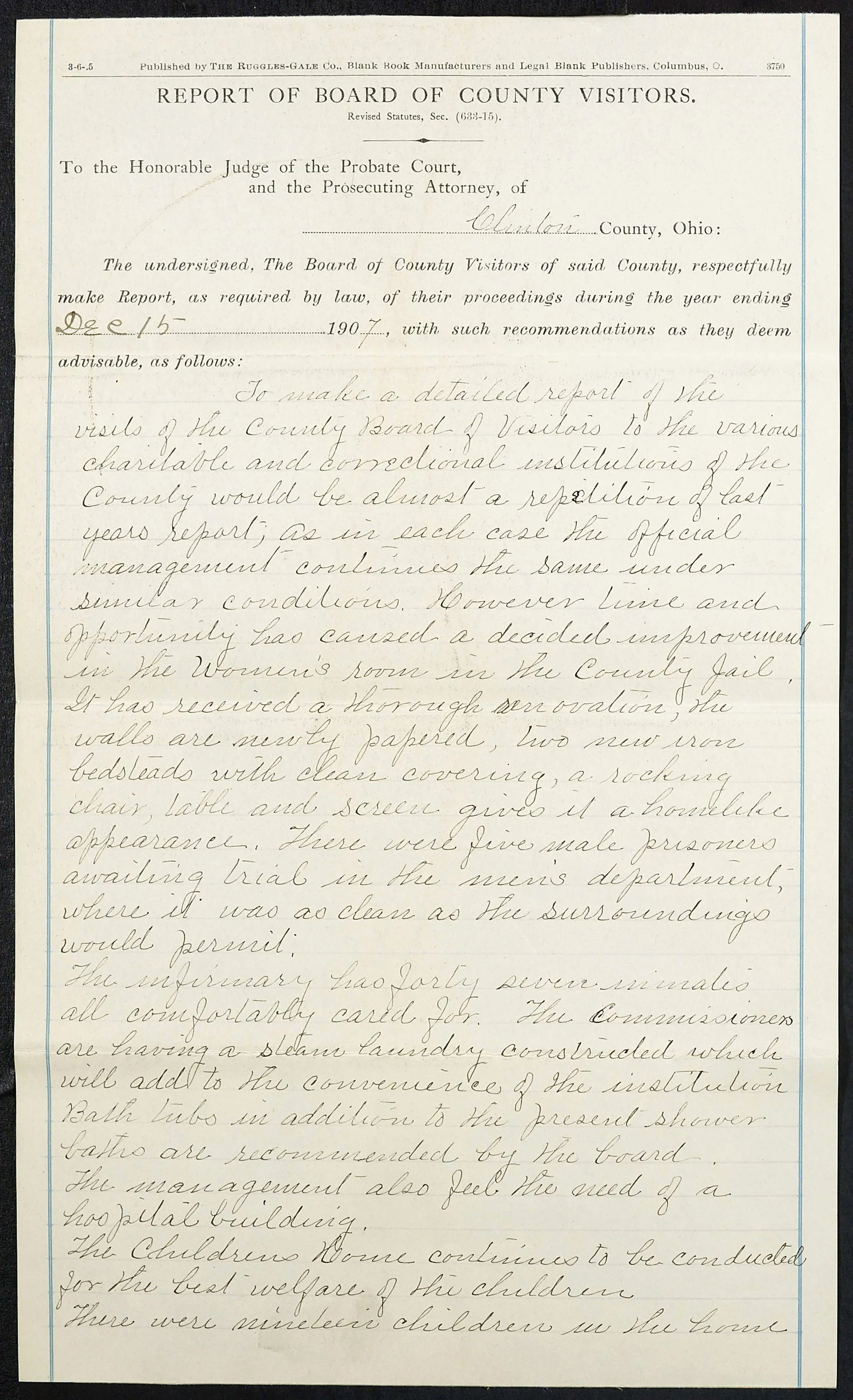
A Board of County Visitors annual report filed with the Clinton County Probate Court. By law the six volunteer members filed a full report each year between November 15 and December 15, with copies sent to the county prosecutor and the Board of State Charities — a paper trail that runs for 60 years and never once names the burying ground. The 1907 report, shown here, recorded 47 infirmary inmates and found conditions satisfactory throughout. (Clinton County Records & Archives)
The One Place the Dead Appear
In all of it, the dead come near the page only once. In its 1893 report — late in the burying ground’s life, about a decade before it closed — the board recommended a “dead-room” to hold bodies until burial. Even that was a concern for the living: the dead, the board wrote, should no longer be carried “through the sleeping rooms of the inmates, as they must now be carried.” The next year the room was built, on the north side. It was a note about how the dead moved through the house — not about where they went, nor which of them went to the farm rather than to family or another ground. That, the reports never say.
He was one of the watched.
The Director Who Named the Oblivion
In November 1901, Harlan was elected to the infirmary’s board of directors, the body that governed it. On July 31, 1902, the directors’ own minutes record, Harlan offered the resolution that ended burial of the institution’s dead on the infirmary farm; thereafter they would be laid in the infirmary’s lots at Sugar Grove Cemetery. Days later, the same board fixed the price of a pauper’s burial — casket, robe and box for $16.50 — and directed that “the coffin and box are in no case to be omitted.” A board whose dead had lain six decades without a marked grave had resolved that the poorest among them would never again go without a coffin.
Five years later, Harlan put words to the wound. Speaking as an infirmary director to the 1907 Ohio State Conference of Charities and Correction, he described how the indigent dead of the old poorhouses would “sink into the place assigned him … in the poorhouse graveyard, and thus from the sight of man into oblivion.” Among the eight duties a county owed every soul in its care, he said, the last was that he “should be buried in a christian grave, in a christian manner.”
The genealogist’s instinct did not stop at his own family. In the institution’s final years under the directors, Harlan turned the same care on its records, returning to the inmate register to set down what the original entries had left out. Beside an inmate recorded only as Mary Sixty — received in December 1854 and reported as an inmate in March 1856 — he added a single line in 1908: “No further record.” Those registers are the reason any recovery is possible at all. The volumes Harlan helped keep and annotate are the very records that Clinton County Genealogical Society volunteers began transcribing in 2011 — first counting 216 of the lost, a number since raised to at least 250. Without his care for the institution’s own books, there would be little left to bring back.
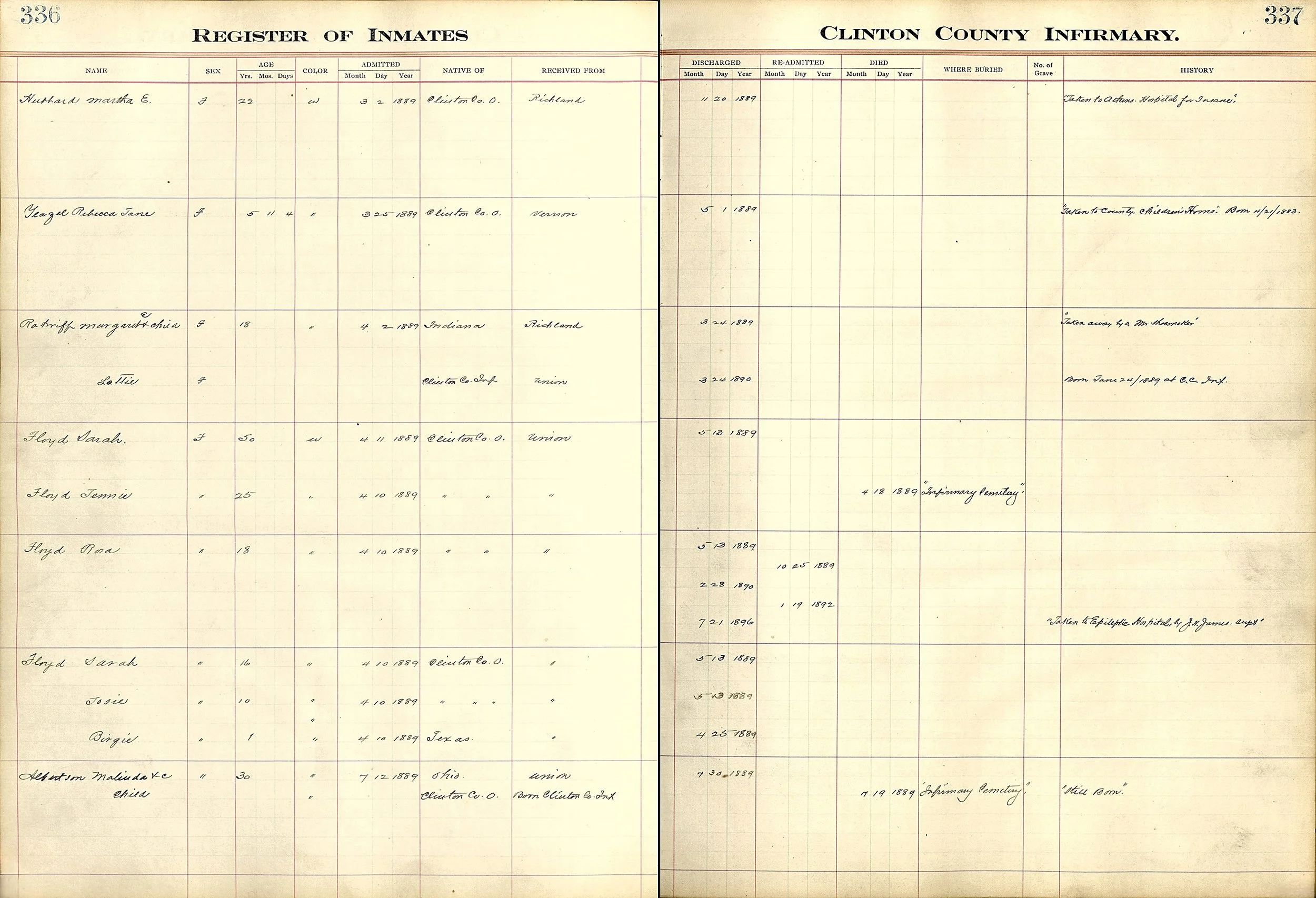
Two facing pages from the Clinton County Infirmary inmate register — County Infirmary Inmates 1835–1918, Book 1 — where the institution’s dead were recorded a single line apiece. The entry at the bottom reads “Albertson Malinda & child”: the child, a sub-entry under her mother’s name, was stillborn at the infirmary in July 1889, and the register records the burial location as “Infirmary Cemetery.” No physical marker on the ground has ever identified the place. (Clinton County Records & Archives)
There is a final turn. In 1912, four years after he left the infirmary board, the court named Harlan to the Board of County Visitors itself. The man who closed the Obscure Lot had become one of the watchers — the body whose 60 years of reports never named the ground.
Two Lives From the Obscure Lot
Eliza Jane Severs (d. 1901) spent much of her life inside the institution. A pauper from Chester Township, she moved in and out of its care across more than four decades. In 1858 her young daughter Eugenia was taken away to be raised by another family. On September 23, 1867, Eliza Jane gave birth at the institution to a daughter, Nellie, and signed a sworn affidavit as to the child’s father. Readmitted in 1898, she died at the infirmary on April 9, 1901 — during the very years the board of visitors was filing its reports — and was buried in the Obscure Lot. A whole life, with its losses and its returns, survives on a single register page. No marker records the place.
Ada Russell (1858) had almost no life to record. She was found at the infirmary door, “supposedly a few hours old,” and entered in the register under a name someone gave her. She died three months later. No township, no parentage, no story beyond those few lines was ever set down. She is among the youngest the roster counts in the Obscure Lot — a name that exists today only because someone, long ago, wrote it down.
These two lives — the mother whose decades the institution absorbed, and the foundling who barely arrived — are two among at least 250 people buried in the Obscure Lot. Earlier in this investigation I profiled seven others, along with Samuel Hadley, the Quaker farmer and infirmary director who helped shape the institution. From 1835 to 1989, the institution touched nearly 3,000 lives. The Obscure Lot works to return names and stories to as many of the people in it as the records preserve — the veterans, the laborers, the children — brought back, one by one, from silence.
If your family’s trail has gone cold, it starts here: www.thegraveguy.com/grave-survey

