
Sugar Grove’s Designer Supplied the Trees Beside the County’s Lost Graves
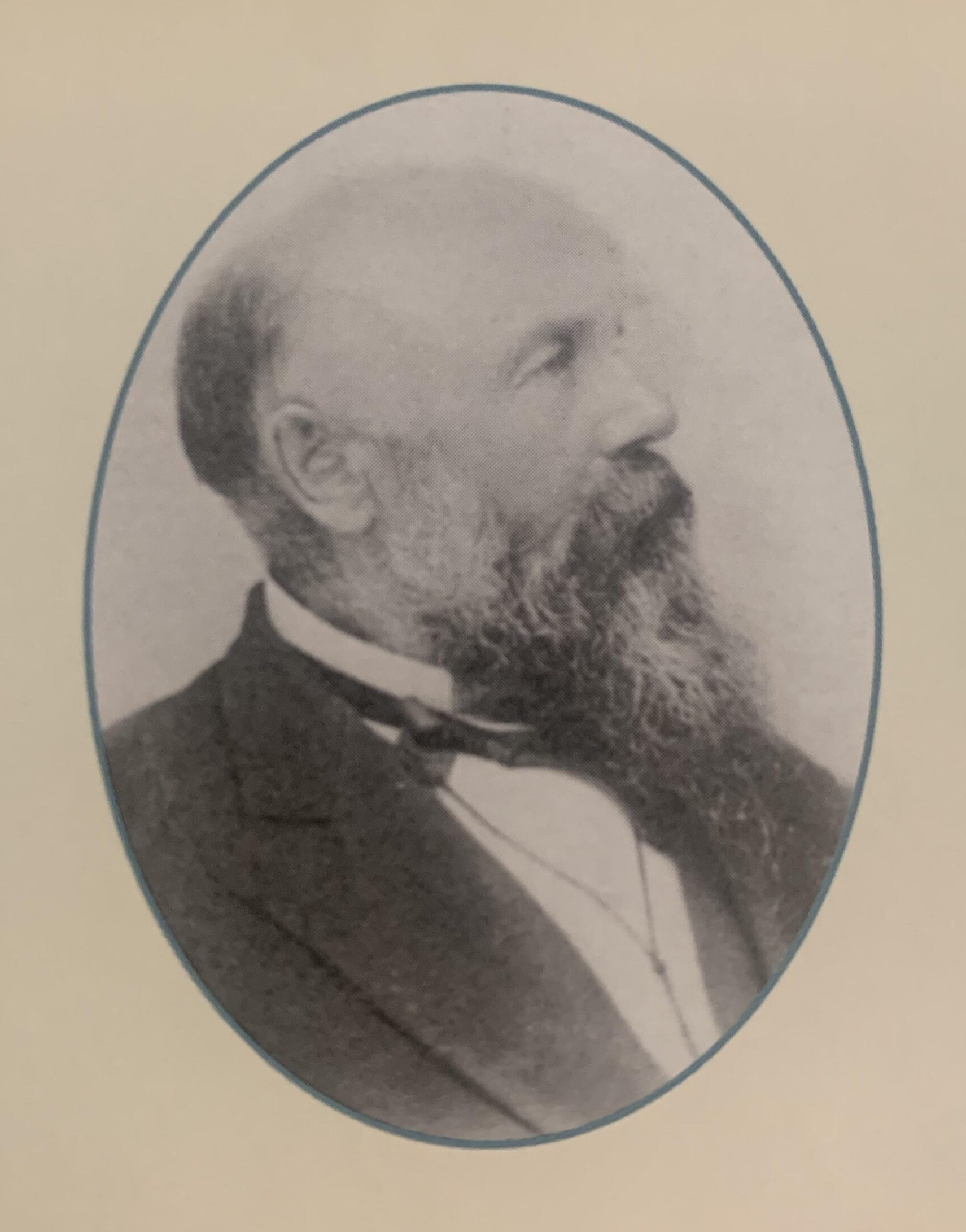
Leo Weltz (1825–1890) came to Ohio from Prussia in 1851 and served for more than three decades as superintendent of Sugar Grove Cemetery, building one of the region’s largest commercial nurseries alongside his design practice. A regional newspaper in 1868 called him “the best practical landscape gardener in the West.” Courtesy of the Clinton County History Center.
On a Thursday morning in July 1874, the executive committee of the Ohio State Horticultural Society made its way to the Clinton County Infirmary farm. The state’s leading fruit men had come to see its orchards, and the county farm did not disappoint: the visitors found a good crop growing and “scarcely a defective apple could be found.” Dr. John A. Warder, the society’s president, knew where to place the credit. “It was fortunate for Clinton and Warren counties,” he observed, “that among the early settlers, there came a class of persons called Quakers, remarkable for their industry, thrift and intelligence; they planted the best fruits and gave them much attention.”
mention what lay near the trees.
By the summer of 1874, the infirmary farm had been receiving the county’s poorest dead for more than three decades. Their resting place was what a period newspaper would call the “obscure lot” — the lost burial ground of the Clinton County Infirmary, where at least 250 men, women and children were laid to rest without headstones or recorded grave locations between 1840 and 1903. For more than a century, their names existed only in institutional registers and the transcription work that Clinton County Genealogical Society volunteers began in 2011.
Making the Land Pay
The institution was a working farm from its first year. Its earliest published financial record — the exhibit covering March 1836 to March 1837 — already shows $8.01½ for “fruit trees & hauling,” planted when the Poor House was barely a year old. By the 1850s the farm’s exhibits recorded hundreds of bushels of wheat and potatoes and more than 100 bushels of winter apples in a season. Residents who were able worked the land — clearing brush, tending the vegetable patch, bringing in the harvest. The farm fed the institution, and in good years it did more than that, returning a surplus that spared county taxpayers part of the cost of caring for the people who lived there.
The Cemetery Designer’s Trees
The man who supplied the orchard’s trees was the most accomplished horticulturist the county ever produced. Leo Weltz, a Prussian-born nurseryman and landscape gardener, designed Sugar Grove Cemetery in Wilmington, Ohio, in 1857 and went on to lay out burial grounds across Ohio and into Indiana — London, Springfield, Greenfield, Martinsville, Rushville. By 1870 his Wilmington nursery advertised more than 60,000 apple trees in stock. Families sought him out to design the grounds where their dead would be remembered.
In April 1868, the infirmary directors paid Weltz $64.60 for trees for the county farm. The same hands that drew the winding drives of Sugar Grove supplied the orchard that grew beside the ground where the county buried residents who had no one else to bury them.
Weltz’s standing in his field was not local courtesy. At the state society’s 1880 meeting, Warder — speaking from the president’s chair — told members who wanted to see cemetery design done properly to go to Wilmington and see the grounds Weltz had laid out. Five years on, the federal government sent Weltz himself abroad — an 1885 commission to Russia in quest of hardy fruit varieties for American growers.
The Ground Beside the Trees
The county always knew the ground was there. In 1847, seven years after the earliest documented burial, the directors recorded $17.66 for “Building Fence around Grave Yard” — the institution’s first documented act of setting its dead apart from the working farm.
In July 1902, the Board of Directors resolved that future burials would go to Sugar Grove rather than the farm. The first to go was a resident who fell from the hay mow that summer and died of his injuries — buried at Sugar Grove, the Clinton Republican reported, under the new arrangement that residents would rest in the cemetery “rather than in an obscure lot on the Infirmary grounds.” The paper endorsed the change: “The new arrangement strikes us as being the proper thing.” That same season, the directors paid $138.25 to Leo Weltz & Sons — the founder’s sons had carried on the firm — for “Trees for new Orchard.” In March 1908, the Board paid Fremont Weltz $20 to trim both the new orchard and the apple trees lining the front drive. Five years later, the Board of Infirmary Directors was abolished.
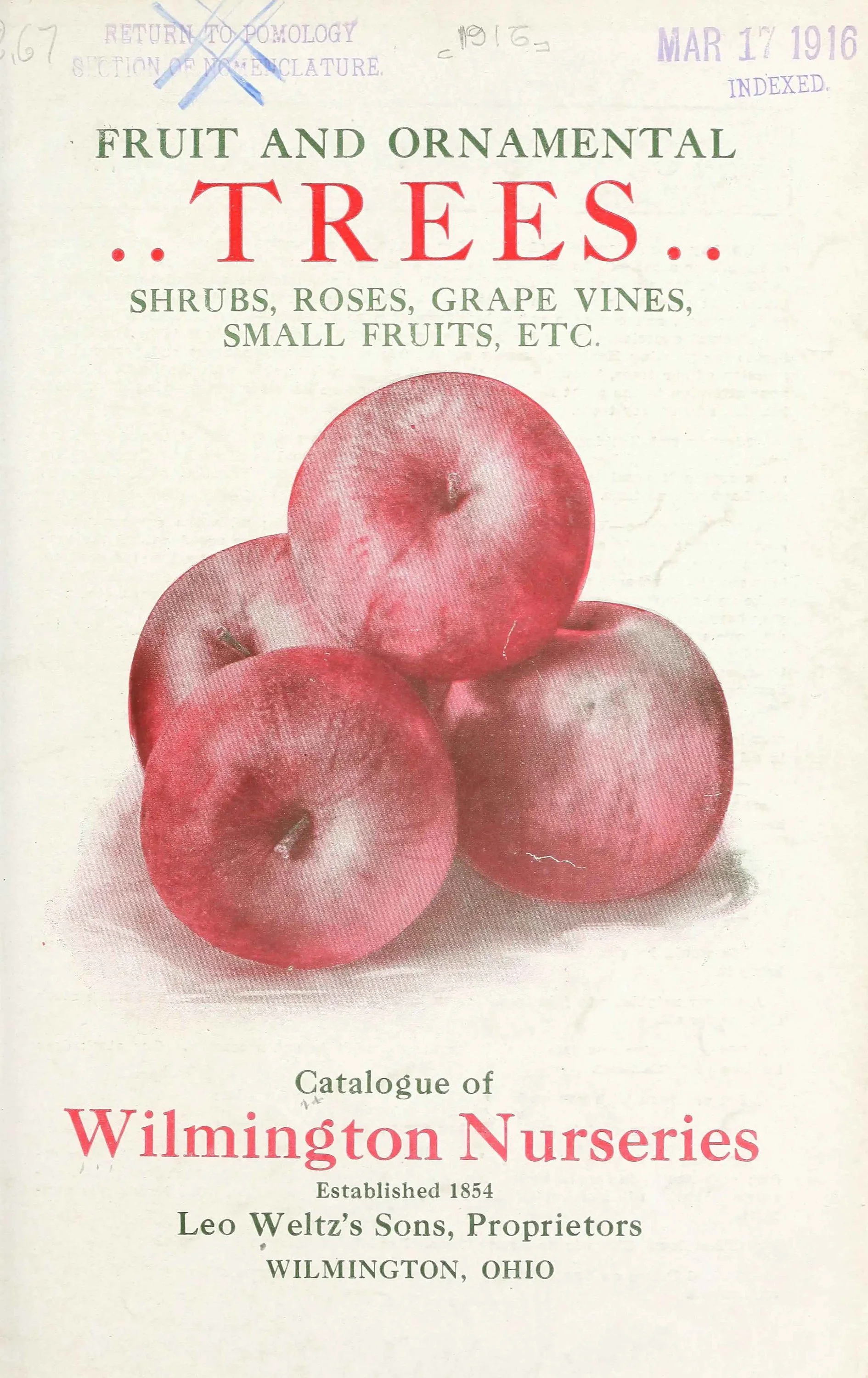
The 1916 trade catalogue of Wilmington Nurseries, printed 62 years after Leo Weltz founded the firm his sons had come to operate. The catalogue listed cemetery design and landscape work among its offerings — the same work that had placed the Weltz name on Sugar Grove and burial grounds across Ohio and into Indiana. From: Leo Weltz’s Sons, “Catalogue of Wilmington Nurseries,” 1916. Henry G. Gilbert Nursery and Seed Trade Catalog Collection, U.S. Department of Agriculture, National Agricultural Library; public domain.
When the county agent inspected the long-neglected orchard in 1925, he counted 254 trees, all about 25 years old — the generation planted in 1902, grown to maturity beside the retired burying ground. After a season of scientific pruning and spraying, the orchard cleared $653 — for a brief moment, a model county asset.
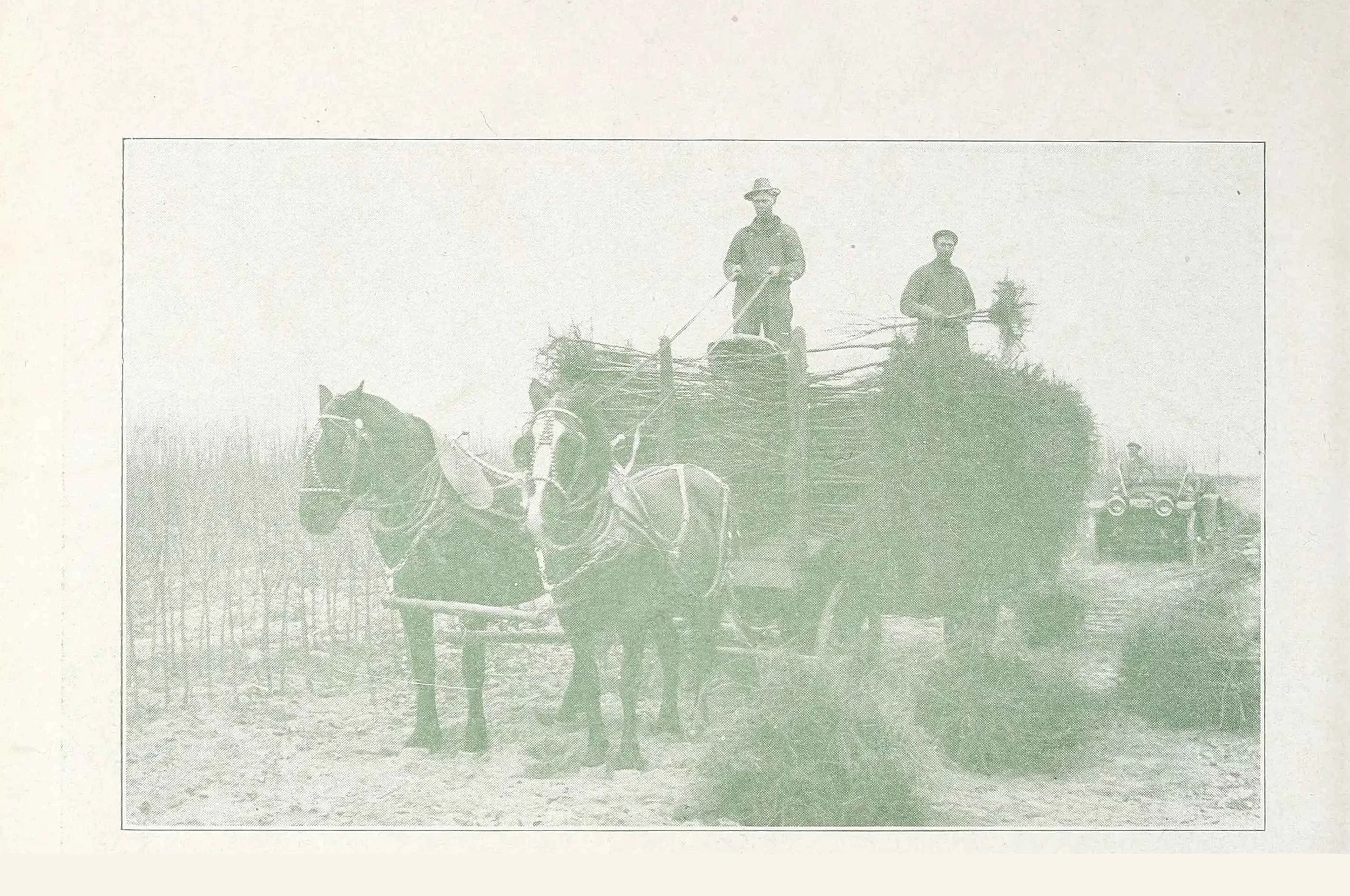
The back page of the same 1916 catalogue captures nursery workers loading bare-root apple trees for transport to the packing houses — the kind of stock the firm shipped to farms, orchards and cemetery grounds across the region. In its 1925 demonstration year, the infirmary orchard’s fruit was exhibited at the Wilmington, Blanchester and Dayton fairs; public interest ran so high that the entire crop sold locally without difficulty. From: Leo Weltz’s Sons, “Catalogue of Wilmington Nurseries,” 1916. Henry G. Gilbert Nursery and Seed Trade Catalog Collection, U.S. Department of Agriculture, National Agricultural Library; public domain.
Whether the infirmary orchard was a memorial, a screen or simply good farming, the record does not say. But the design philosophy of the age — one Weltz himself endorsed — treated trees as fitting memorials. In a paper read at that same 1880 meeting, Warder offered a living alternative to the stonecutter’s trade: some, he wrote, would prefer “planting a memorial tree to mark the last resting-place of their departed friends.” Even “the first and simplest attempts at improvement of the old burying-place,” he continued, “should be encouraged, be they only the planting of the commonest evergreens in regular rows and squares like an orchard.” Weltz rose to commend it, saying every cemetery, every society and every county should have the paper.
For four decades after 1902, those trees were the only living landmark beside the retired burying ground. During the war they came down to clear the way for the air field — a story for a later installment in this series.
Two Lives From the Infirmary Farm
Samuel Hale Hadley (1824–1882) was the kind of Quaker farmer Warder had in mind. Born in Adams Township, a lifelong member of the Society of Friends, he worked a 200-acre farm on the old Cincinnati road and served two terms as an infirmary director, from 1869 to 1876. His obituary credited those years with many of the institution’s buildings and improvements. He was secretary of the Wilmington College Board of Trustees from about 1870 until his death — 12 years a colleague of Joseph Wright, the Quaker minister this series has already introduced. It was Hadley — whose own farm the delegation toured that same week — who arranged the 1874 showcase. His obituary, remembering “one of our best farmers, a man of great industry,” was written by W.P. Wolfe, a newspaper correspondent and former infirmary director who had walked the infirmary orchard with the delegation Hadley organized eight years before.
Susan Bowermaster (d. 1846) came to the county Poor House from Greene Township, a native of Clinton County. The township trustees who sent her there in February 1845 described a “sober, moral woman,” about 21, who had “labored under the palsy, and subject to fits” for some five years, with “no probability that she will ever recover.” By the time she was admitted that June, the record gave her age as 23 — even her years shifted as different hands wrote them down. She died on December 10, 1846, after roughly 18 months at the institution, one of two deaths it recorded that year among the 32 people it sheltered. The same annual accounting that set down those deaths carried another line: $17.12½ in funeral expenses. She was buried in the Obscure Lot. No marker records the place.
These two lives — Samuel Hadley, who made the county farm a showcase, and Susan Bowermaster, whom the same ground had received a generation before — frame the years the orchard grew. Earlier in this investigation I profiled six people buried in the Obscure Lot — Walter Roberts, George Wright, Harley L. Welch and Margaret Black, and Eliza Chenoweth and Mary McKinney. From 1835 to 1989, the institution touched nearly 3,000 lives. The Obscure Lot works to return names and stories to as many of them as the records preserve — brought back, one by one, from silence.
If your family’s trail has gone cold, it starts here: www.thegraveguy.com/grave-survey

