
World War II Reached the Infirmary Farm, and the Orchard Beside Its Graves Fell
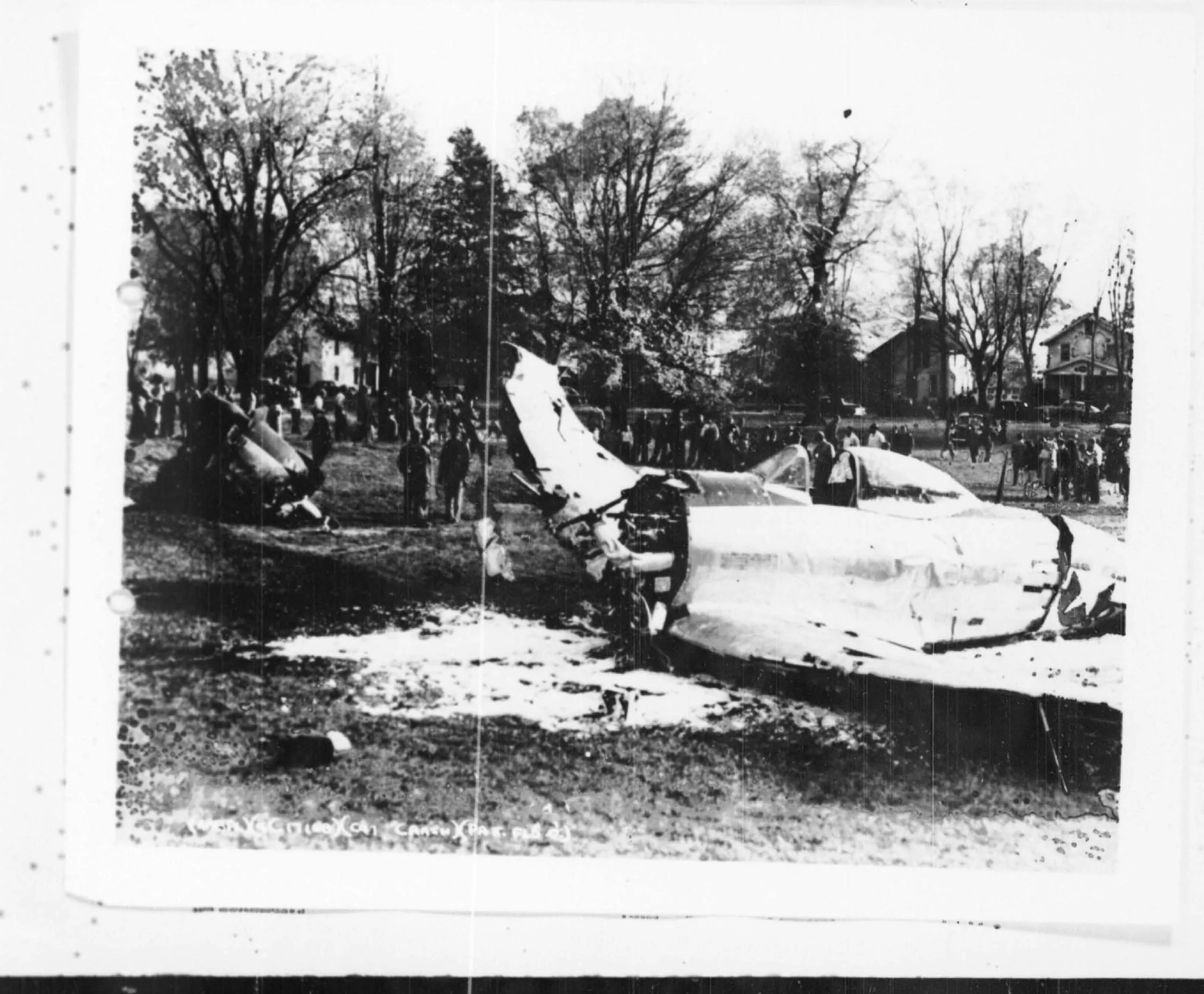
The wreck on the Wilmington College campus, October 26, 1944: Onlookers ring the P-47 where it came to rest — in “a small tennis court,” by the pilot’s own account — its engine torn from its mount and lying about 40 feet ahead of it. Maj. William A. Simms walked away and directed the crowd back from the wreckage. From official accident-report file no. 45-10-26-15, Air Force Historical Research Agency (AFHRA), Maxwell AFB, Alabama; U.S. Government work, public domain.
Charles Hart Jr., a Wilmington College freshman from Richmondale, was washing windows on the south side of the college library in Wilmington, Ohio, when he heard the airplane. He got off his ladder and watched it come through the trees — a P-47 fighter, its engine shearing off two of them, he would tell the Army’s investigators, before it hit the campus lawn sideways and caught fire on October 26, 1944. The pilot, Maj. William A. Simms, got out and directed onlookers back from the burning wreckage.
Simms had taken off on the east-west runway at the Clinton County Army Air Field, in Clinton County, Ohio, and could not climb — he was on a test hop after an engine change there. He reached, he said, about 60 feet, “hoping to clear some trees and a college, which were immediately in front of me.” Investigators found nothing wrong with the engine; the official cause reads, “Believed poor technique on part of Pilot but not proven.”
The field the plane could not climb away from was built on and around the old farm of the Clinton County Infirmary. Beside it lay what a period newspaper called the “obscure lot,” the lost burial ground where at least 250 men, women and children were laid to rest without headstones or recorded grave locations between 1840 and 1903. An orchard planted in 1902 stood for four decades alongside the retired lot. By the fall of 1943 the trees had come down as a hazard to flight, and the county accepted $500 in damages for their clearing. Nothing was left on the surface to say the burying ground had ever been there.
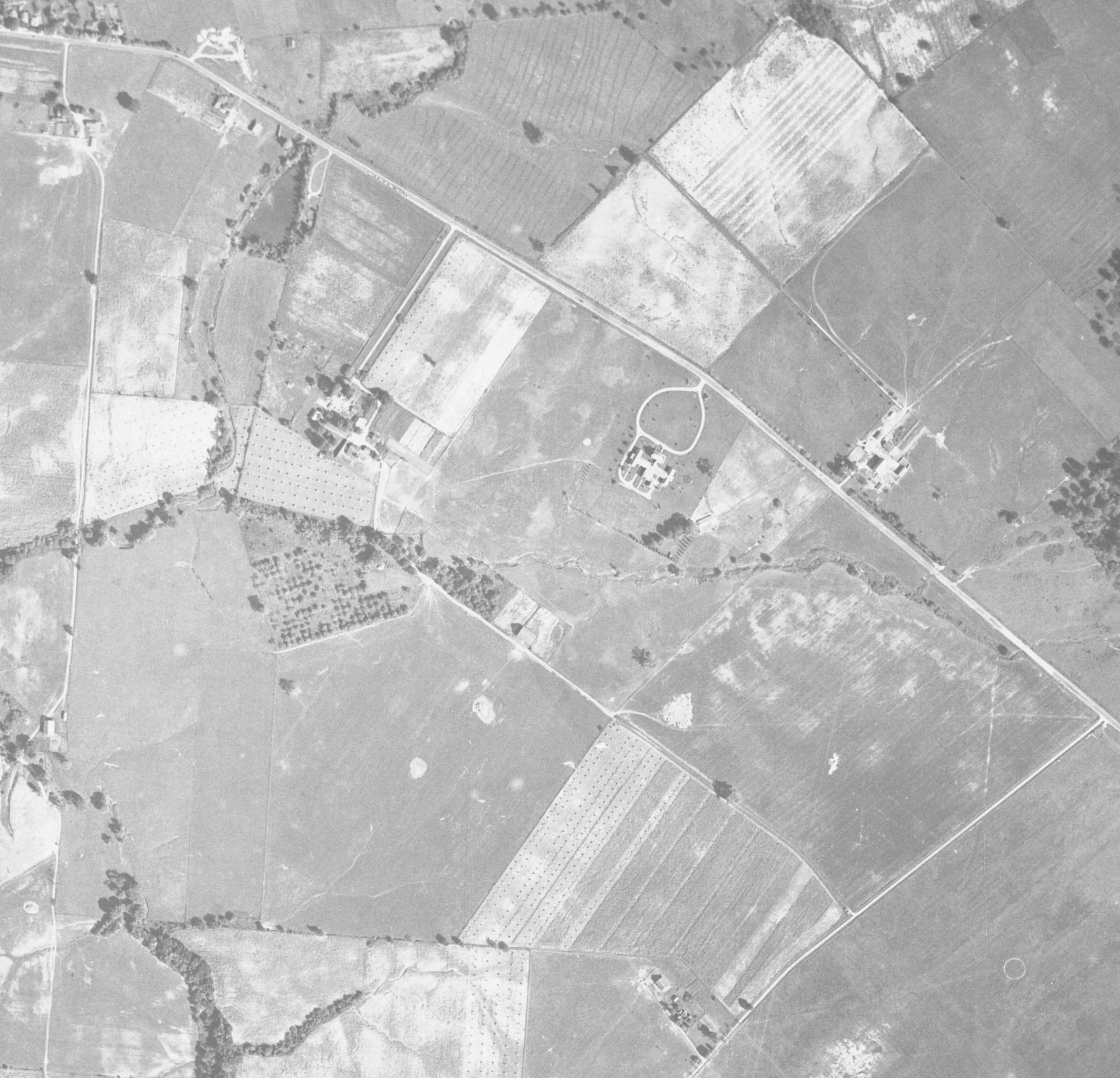
Clinton County Infirmary Farm, September 26, 1938 (aerial): The federal government’s own camera preserved the orchard five years before it came down. This Agricultural Adjustment Administration survey photograph records the grid of the 1902 planting beside Lytle Creek, the image whose later analysis helped anchor the burying ground within the original 1835 parcel. National Archives, Record Group 145, Can DN0843, Roll DS-3-3; public domain.
The Airfield Arrives
The war came for the farm in September 1942, when the United States began taking 507 acres of Union Township, Clinton County, Ohio, farmland by eminent domain. Across 1943 the county conveyed pieces of the infirmary farm to the government by resolution. By July the new field was open, and the Army’s glider experiment branch moved in on the 15th.
It began breaking aircraft almost at once. Gliders came down on the farms around it, and its own base operations officer had already told the town what a westward takeoff meant: “we go right over town,” he said in July 1943. Fifteen months later, Simms’ fighter came through the college treetops.
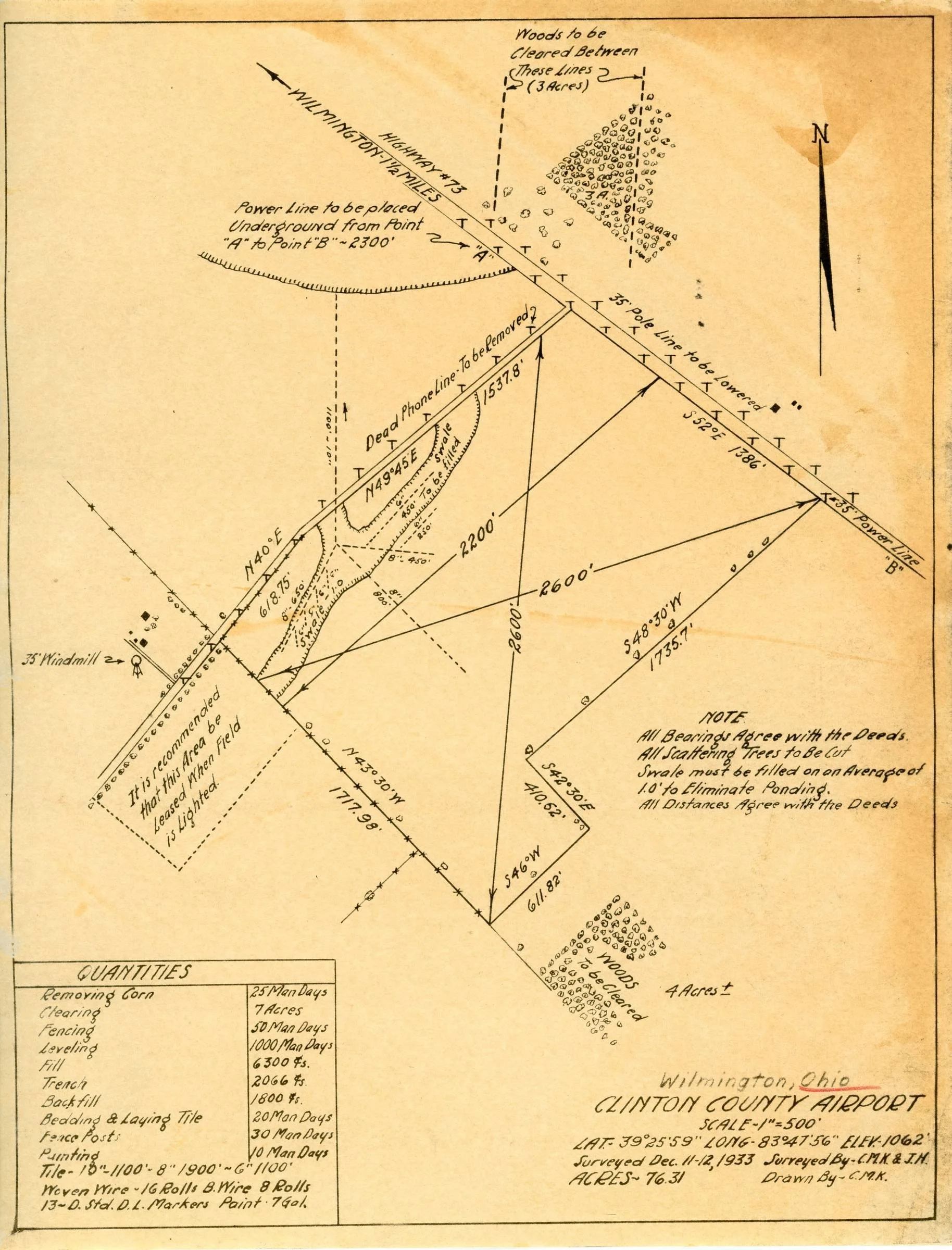
Clinton County Airport survey blueprint, December 1933: A decade before the orchard came down, the county’s WPA airport drawing already prescribed clearing trees on infirmary farmland — “All Scattering Trees to Be Cut,” seven acres of woods marked in two stands, with 1,000 days of labor for the leveling. The commissioners passed their resolution while the survey crew was still in the field. National Archives photo no. 69-AAA-OH-1, Record Group 69, WPA Airways and Airports Series; public domain.
Life on the Farm
The farm was not scenery. It was the institution’s living, and the people the county kept there ran it.
Eva Wallace Vanniman Botts was the superintendent’s daughter who lived there from 1938 until after the war. In her memoir of those years, she recalled the working nature of the farm: a resident ran the cream separator; another raised the 300 baby chicks her mother started every spring; others picked up potatoes behind the digger, shocked wheat, put up hay and worked the barns. “The outside work,” Botts wrote, “was a way they still felt needed.” And there was the orchard behind the old infirmary building. Its apples went to a room in the new building’s basement, beside a press where every fall cider was made.
Not every account of the farm was so warm. In September 1940, an anonymous resident wrote to the state welfare department and alleged there had been nothing fit to eat for a month. The writer claimed twelve people in the superintendent’s household ate the season’s one mess of tomatoes, at three times what it cost to feed the residents. “The county commissioners will be here for dinner,” the writer said in the four-page letter written in pencil on blue-lined paper; they would “have everything to eat,” and “they killed a lot of chickens to get ready for them.” The writer, who signed nothing for fear of being put out, asked the state to carry the complaint higher — “to the Governor if need be.”
Botts, from the other side of the door, remembered that meal too: once a month, on fine linen and good china, in the formal dining room.
A state inspection in June 1943 — nearly three years later, under the same superintendent — found the buildings in excellent shape and food abundant on the farm, and counted about 40 people living there. Both accounts survive. Neither cancels the other.
Seven months later, the strain hadn’t eased. A January 1944 visit found the women’s wing without an attendant, a nurse or a maid. Mrs. Wallace was cooking for her own family and the staff, cleaning that side of the house herself, and keeping the books — while cooks and attendants elsewhere in the home were paid $40 a month. The inmates, the visitor wrote, still appeared clean, the home still in good condition.
The $500 and the No Vote
By the time the commissioners took the matter up in October 1943, the orchard was already gone. Resolution No. 150, adopted October 4, accepted an appraiser’s estimate of $500 for damages to the County Home “incurred in clearing Tract No. 2A” — the tract holding the orchard and shade grove planted in 1902. H.H. Magee moved it; Matthew B. Fife seconded. The roll call is still in the Commissioner’s Journal: Fife, yea. Magee, yea. A. Clyde Fisher, nay. It was the only no recorded in the county’s airfield dealings that year — not obstruction, since Fisher had voted yes on every other conveyance the board made for the field.
Neighbors who dealt with the government won protections in writing. A decree for Russell and Grace Leaming exempted, by name, a tenant house, its shade trees, a corncrib and a windmill.
Five months later the $500 appeared again, in an easement entered in the county’s deed books.
The easement set the power.
Fisher put his reason on the record himself two years later, running again. In a paid campaign advertisement in the March 12, 1946, News Journal, he revisited the clearing of the orchard at the County Home. Fisher said the $500 was not in line with what individuals around the airport had been paid for their trees. Then he told any doubtful voter where to look: go and read the roll call at the commissioners’ office, he wrote, and “you will find my vote was ‘Nay.’”
The advertisement named what came down: the orchard and the shade trees at the County Home. What it did not name was the burying ground the orchard stood beside for more than four decades.
How the Trees Came Down
In March 1943 the commissioners announced that the hay would be baled out of the infirmary barn and the barn moved off the land the airfield was taking. Work began the next month. The News Journal reported that the county hired a mover for $750, furnished him six men and appropriated $1,500 more for a new foundation. The barn was moved down the hill, across Lytle Creek and up the far side to be placed behind the new infirmary building.
The orchard was 41 years old that fall — a county count in 1925 had found 254 trees. In September 1943, the same month the county’s own trees were coming down, the Ohio Agricultural Experiment Station published the standard method for taking out an old apple orchard.
A tree that age could not be pulled with a direct hitch. Block and tackle risked the “upheaval of large quantities of soil,” and the alternative was dynamite — a hole bored slantwise beneath the heart of the tree, at least 3 feet deep, 2 to 3 pounds of charge and the workmen standing back 100 feet.
The easement the county granted five months later gave the United States the right to “cut and remove trees, underbrush and soil.”
The tract-clearing resolution in the commissioners’ journal points to more: “see contract on file in the County Commissioners office.” But that contract has not been located, and no surviving record names the methods used to clear the orchard, or the men who did the work. And none names the burying ground the orchard had stood beside.
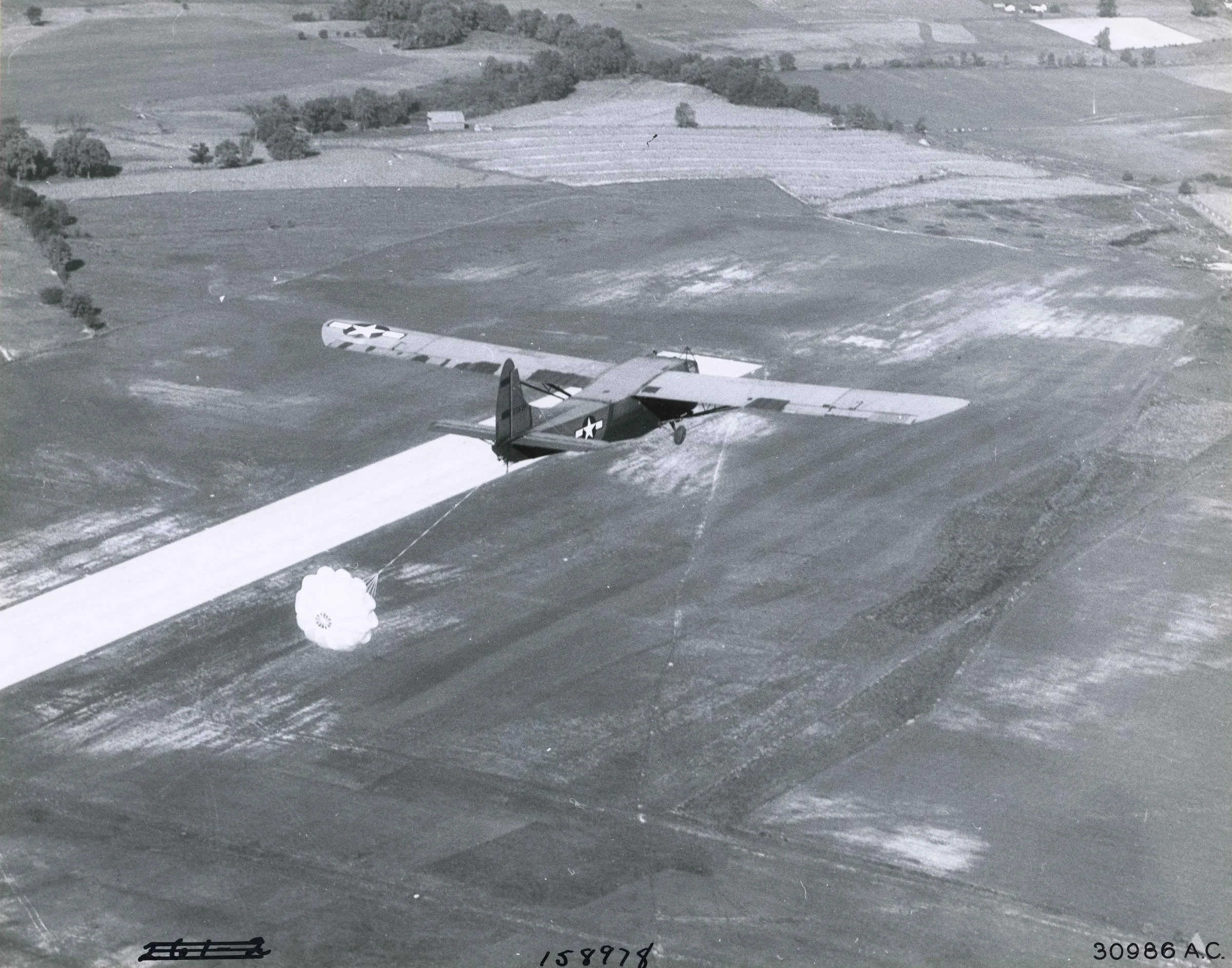
The cleared orchard tract from the air, 1944: At the upper right lies the ground where the infirmary orchard had stood before it was cleared for the airfield, photographed as a Waco CG-4A glider descends over the east-west runway. The parcel was identified by matching the runway alignment, terrain and flight direction against the survey record. A year after the clearing, nothing on the surface marked the orchard or the burying ground beside it. National Archives photo no. 342-FH-B31752; public domain.
One Life From the Obscure Lot
George Raymond Newton (1899–1903) was two years old when his mother died. Alice Newton of Jefferson Township, Clinton County, Ohio, a railroad section laborer’s wife, died on a Friday morning in April 1902 after two weeks’ illness — the News Journal counted “five little children” left behind. On Monday the county received the youngest of them at the infirmary: George Raymond, aged two years, eight months and nineteen days by the register’s careful arithmetic. Within a month, the probate record shows his brothers and sisters scattered across four towns.
He lived nine months on the farm. When he died on February 12, 1903, the register — by then recording Sugar Grove as the burial place for those who died at the infirmary — recorded nothing at all beside his name. He was three. No other burial place has ever been found for him — the reason the Clinton County Genealogical Society volunteers who spent 15 years with these registers count him among those buried there. His is the last burial the research confirms.
He is one of at least 250 people buried in the Obscure Lot. I am assembling their history into a book, The Obscure Lot, returning names and stories to as many of them as the records preserve — brought back, one by one, from silence.
If your family’s trail has gone cold, it starts here: www.thegraveguy.com/grave-survey

