
Something Grew Over the County’s Lost Graves Until the Landfill Reached It
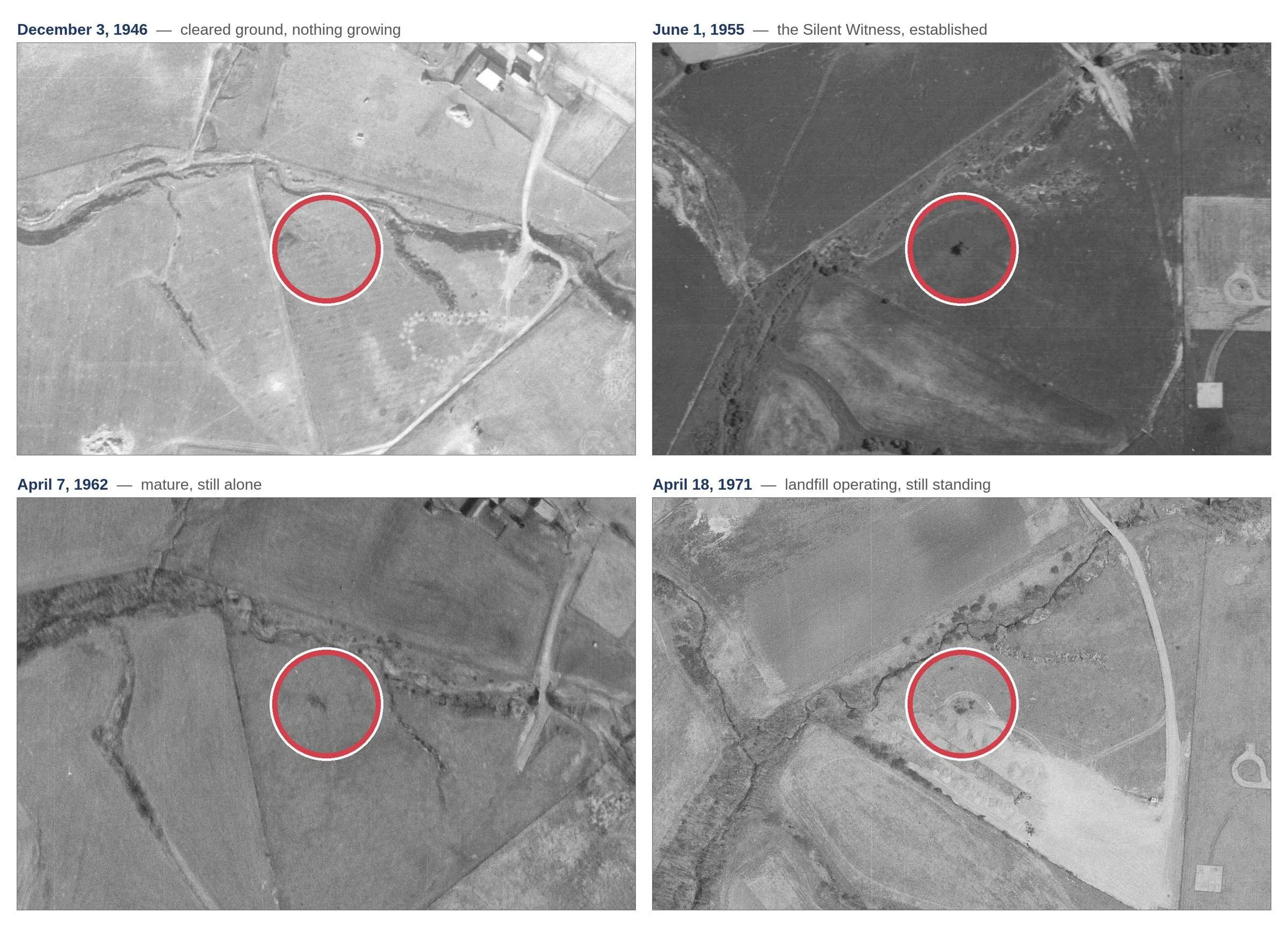
The Silent Witness, 1946 to 1971: Four frames from the county’s aerial record. In December 1946 the ground lies bare, three years after the orchard came down. By June 1955 something is growing there. By April 1962 it has filled out. In April 1971 it still stands while the landfill works around it. Across every flight that caught it, the crown widens and the leaves come and go with the seasons — a tree or large shrub, never identified by anyone who worked the ground. A 1974 frame, too coarse to reproduce, shows it gone. Source: Ohio Department of Transportation Aerial Imagery Archive.
In May 1947 a state welfare inspector came out to the Clinton County Home near Wilmington, Ohio, and found Roy Painter, its new superintendent, on his way to plant corn. The ground was right, Painter told him, and rain was coming that night. It had to go in. The inspector filed the visit to Columbus, Ohio, with a judgment of his own, set in parentheses: “again farm before people.” That August the county paper reported Painter’s nine acres of oats had made 80 bushels to the acre, in a year when much of the county’s crop was not worth combining.
Four years later, on May 13, 1951, a survey aircraft passed over the same farmland, and its camera caught something new: a single dark fleck of growth standing alone in a cleared field on the old Clinton County Infirmary farm. It appears in the next aerial photograph, and the next, and the next — through the 1950s and into the 1960s — larger each time, alone each time.
In the frame dated April 18, 1971, it is still there, the tracks of heavy equipment curving around it. In the next frame, April 30, 1974, it is gone, and the Clinton County Landfill covers the field where it grew.
The field was not empty. It held what a period newspaper called the “obscure lot” — the lost burial ground of the Clinton County Infirmary, where at least 250 men, women and children were laid to rest without headstones or recorded grave locations between 1840 and 1903. The orchard planted beside the retired lot in 1902 came down as a flight hazard in 1943. A state survey flight found the ground bare three years after that; by 1951 something was growing.
It may have been planted by a hand that remembered, or risen on its own from the roots of the felled orchard.
for 20 years the only living thing above the county’s dead.
This is the account of how it, too, was erased.
The Silent Witness and the Keepers
The superintendent the inspector met that May was three months into the job: in February 1947 the commissioners appointed Roy and Hazel Painter together as superintendent and matron of the infirmary. Hazel Thatcher Painter was a great-grandniece of Azariah W. Doan, the Quaker judge who half a century earlier had seen that a man from the institution was not committed to the earth in silence. They took charge on March 1 and kept the place 16 years. The frame showing bare earth was taken three months before they arrived.
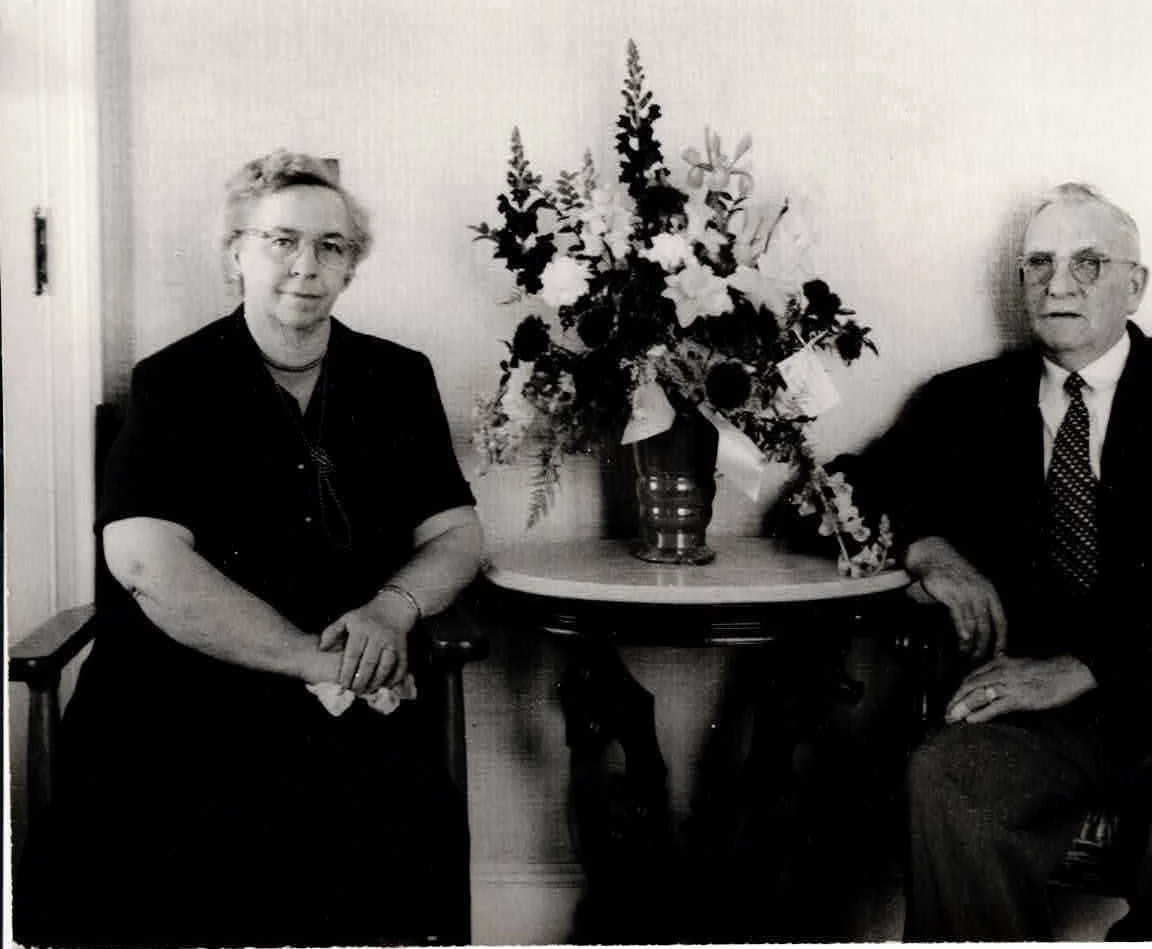
Roy and Hazel Painter, superintendent and matron: The couple ran the Clinton County Home from 1947 to 1963 — the years the Silent Witness was rising in the field beyond. On Valentine’s Day 1955 a Wilmington florist’s weekly column named them its Bouquet of the Week, an award readers nominated their neighbors for, and closed by inviting the public to come out and visit the infirmary. Roy came to the job after 16 years with the county highway department. Courtesy of the Kelly Hopkins family collection.
Whether they, their staff or a resident set it there is not something the record answers, and this research does not claim it. Nothing in an aerial photograph distinguishes a planting from a root that survived the felled orchard. Two state officials walked that property inside the window, in May 1947 and June 1949, and neither wrote a word about a burying ground.
The June 1949 visit found 54 residents, four employees, a sick room with three beds and a pool table. Roy was not available; his wife took him through the home, which he called “really home-like.”
Two residents from those years surface in the record. In March 1955 the paper marked the 99th birthday of Ella Runyan, who had lived at the home nine years; Hazel Painter, eight years in the job, said she could not recall a doctor ever being called for her. And Roy Painter’s own older brother, Maurice, entered the home around 1958, while Roy was still superintendent, and died there in 1968.
Both retired on May 1, 1963, to a house on Fife Avenue; Roy Painter died 11 weeks later. Hazel Painter died in February 1969, a year before the landfill plans reached the courthouse.
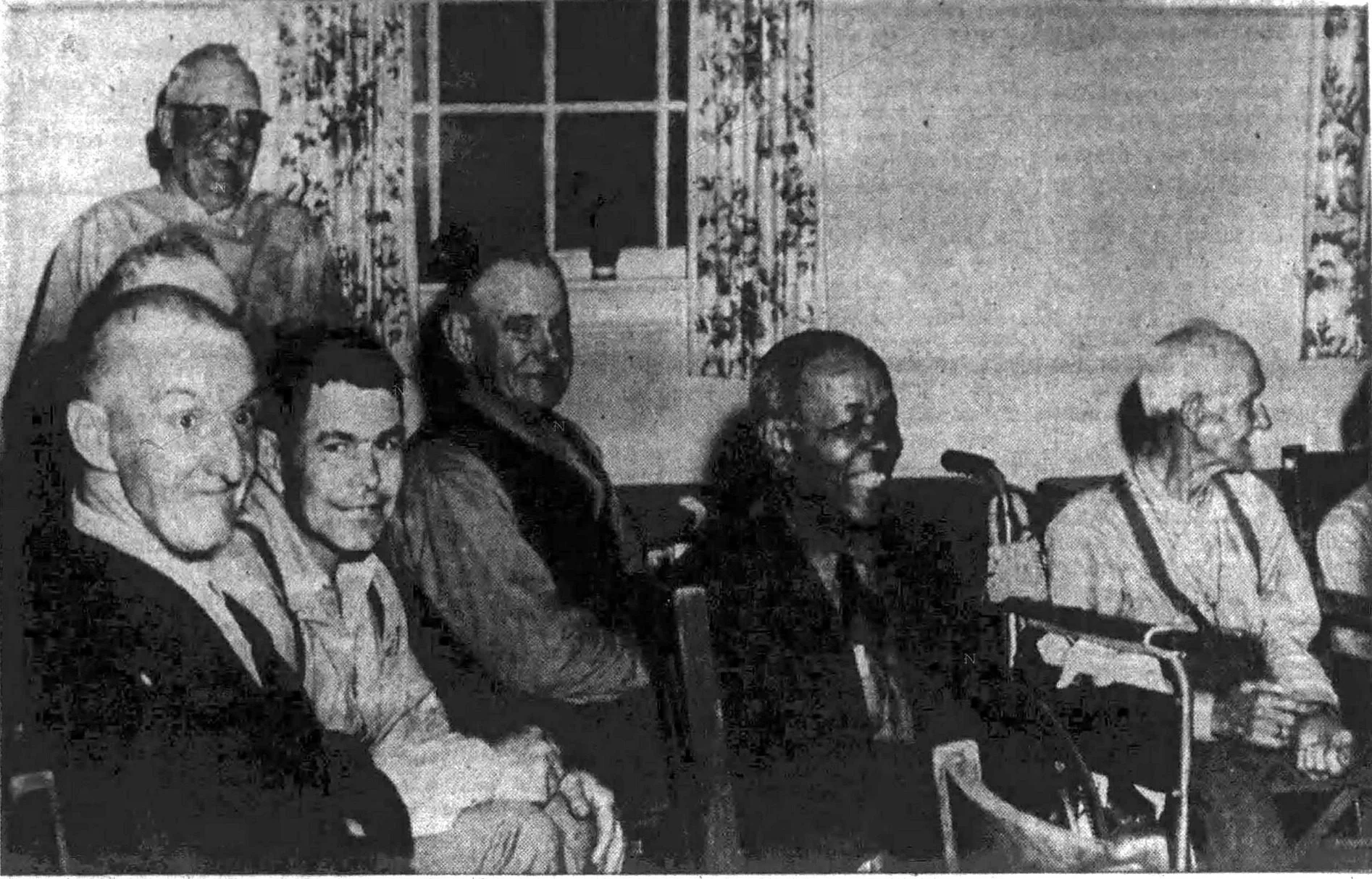
An evening at the infirmary, May 1957: The Clinton County Guild to the Infirmary and Nursing Homes brought a Sertoma Club band out from Xenia, Ohio, twelve housewives in costume, and the room came apart laughing. The residents named in the newspaper’s caption are Charles Sweargin, Lawrence Glass, James Burke, Leonard Stevens and Bert Morris; the superintendent stands at the back. Organizations came out regularly in these years under the Guild’s auspices. Made more than half a century after the last burial in 1903, the photograph shows no one from the Obscure Lot — but these are who the place held for its whole history, county residents with nowhere else to go. Courtesy of the Wilmington News Journal, May 20, 1957.
The Reasons Set on Paper
By the 1960s Clinton County had a trash problem — and the erasure began in the solving of it. Wilmington had a dump, and residents of Union Township, Clinton County, Ohio, could use it. For everyone else the commissioners offered one legal way to be rid of trash, and they put it on infirmary land: a compressor at the county dog pound on Old State Route 73, past the county infirmary.
The compressor was a stopgap; the permanent answer took shape on August 9, 1968, when the commissioners first took up landfill sites. Nineteen days later a state inspector walked the candidate site: about 13.6 acres of county-owned land beside the Air Force base, abutting Lytle Creek — the former infirmary farm. The state found it suitable that December and told the commissioners in January they could proceed. The Silent Witness had been standing there for 17 years.
The only reasons anyone set on paper for putting the landfill on the infirmary farm came from the county health office in September 1969: “The county property on Fife Avenue seems to be ideal for the development of this facility. Roads are built, buildings are available for equipment, and it is centrally located in the county.” Roads, buildings, geography. In the whole record of the landfill’s establishment — a year and a half of sessions, correspondence, plans and inspections — no document mentions what else the property held.
The county owned the land and held the license; the townships paid for it, and their residents dumped free. A county engineer’s drawing laid the farm out in numbered trenches, each with 5 feet of undisturbed earth standing between it and the next.
Columbus approved the plans on February 10, 1970; they reached the courthouse the next day. On February 13, Commissioner D.M. Fife moved Resolution No. 41, accepting the plans and directing that operation “be started immediately.” He was a nephew of the Matthew B. Fife who signed the orchard-clearing instruments of 1943 and 1944. B. Anthony Williams seconded, and with Oscar C. Hackney the roll call was unanimous, the state’s conditions attached: no toxic or objectionable liquid industrial wastes. It was the third resolution of the day, after fund transfers of $486 and $400. The landfill opened Saturday, March 7, 1970.
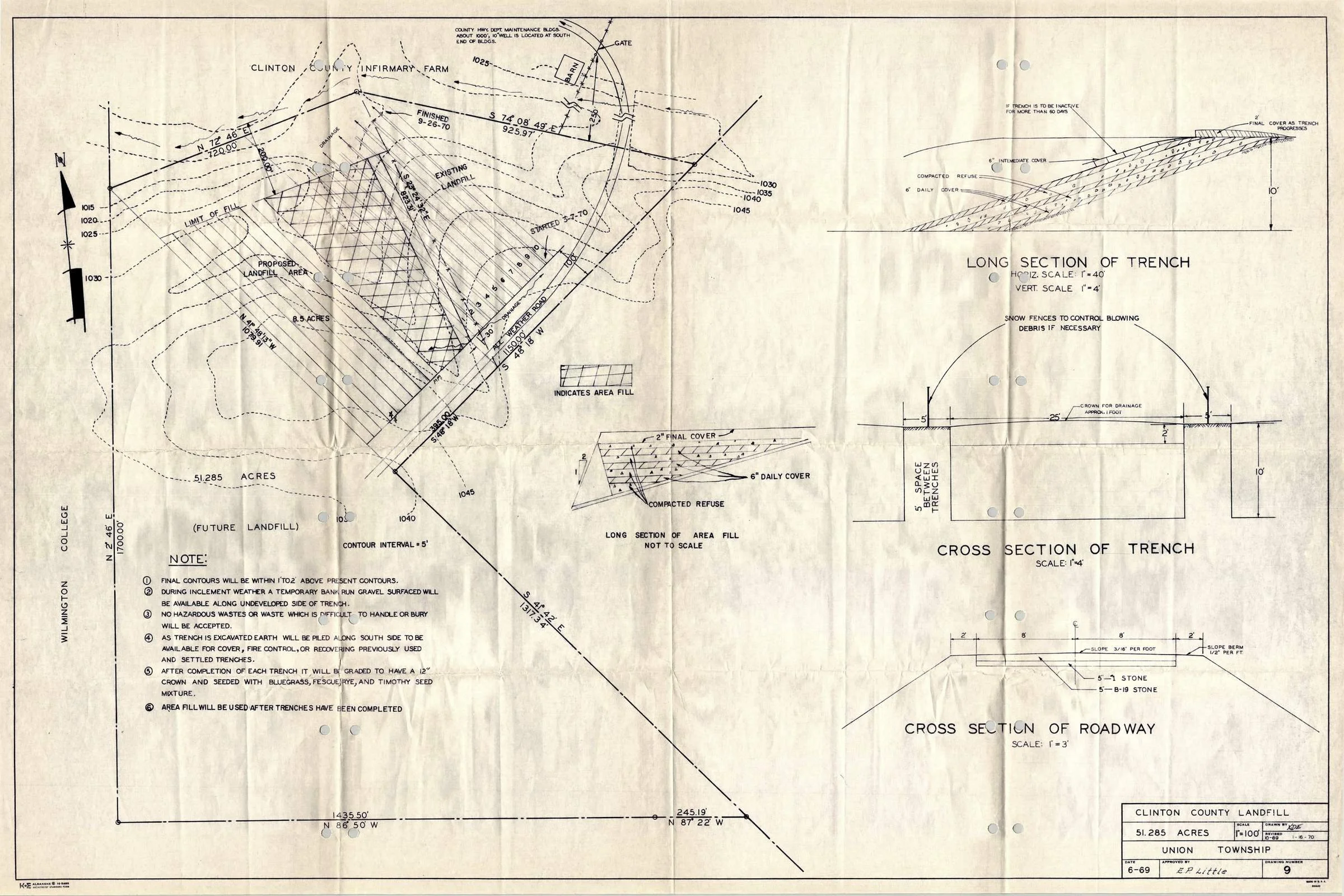
The landfill site plan, June 1969: The drawing the commissioners accepted by Resolution No. 41. The plan carries the ground’s older name across its northern edge: Clinton County Infirmary Farm. It called for 6 inches of cover over each day’s refuse and 2 more when a trench was finished, and barred hazardous waste from the site. The drawing was revised on January 16, 1970 — the same day the completed papers went to Columbus. The license covered about 13.6 acres; the rest of the platted parcel was never filled. Source: Ohio Environmental Protection Agency.
The Trenches and the Creek
The warnings began at once. A June 1970 county health district inspection found open dumping, uncovered waste and an unattended gate — “inviting problems,” the inspector wrote.
By November the failure was structural. The state had specified the 5-foot earth walls and the revised plan carried them; the inspector found none left between the trenches at all — and worse: “Trenches that are apparently for drainage have been dug from dumping areas back to a small creek. This is unacceptable because if water will drain into the creek leachate from the landfill will also ... Follow your plans.” The sanitarian who wrote that, Dan Kennelly, had licensed the site himself nine months earlier: plans approved, equipment available, in his own hand. The creek was Lytle Creek, the water that runs beside the burying ground.
The inspector’s warning aged into the record: by 1986 an Ohio EPA letter, reported in the News Journal, said the landfill was pumping trash-contaminated water into Lytle Creek. The county’s health commissioner, Robert Derge, allowed that it had been approved “when there were a lot fewer restrictions.” In December 1987 Derge announced the end himself, in a News Journal column headlined “Finding a new resting place for those empty Christmas boxes” — effective January 1, the landfill would close to the public. What the column did not name was the resting place already in that ground. The township trustees closed the landfill on schedule, almost full.
Seventeen years of the county’s trash stayed. It came one day a week, on Saturdays: 30 to 60 vehicles in a day’s operation when the site was new, by the county’s own estimate, and 80 to 90 loads a week by the final year, when the News Journal counted them.
What the Ground Was Worth
What the county thought that land was worth is also on paper. In late April 1970, seven weeks after the landfill opened, the commissioners turned to 5 acres immediately west of the cleared orchard lot — not the burying ground, but marginal land along the same creek. Their words for it stand in the journal: land “of no use” in its present condition.
The Silent Witness outlived the Painters, and it outlived the landfill’s opening. Sometime before the 1974 frame it came down, and after that nothing living marked the graves at all.
This year a heritage firm commissioned by the county concluded that the likeliest surviving trace of the burying ground is a clearing at the old orchard’s heart, south of Lytle Creek, at the margin of the landfill. The landfill’s boundary reached — and may have crossed — the ground that held the county’s dead. In July ground-penetrating radar went looking for what the trash did not take.
The Wilmington city dump on Nelson Road and the Clinton County Landfill on Fife Avenue were separate facilities under separate jurisdictions; this story addresses the county landfill.
If your family’s trail has gone cold, it starts here: www.thegraveguy.com/grave-survey

