
Trees Marked the County’s Lost Graves Once; the Trees There Now Cover a Landfill
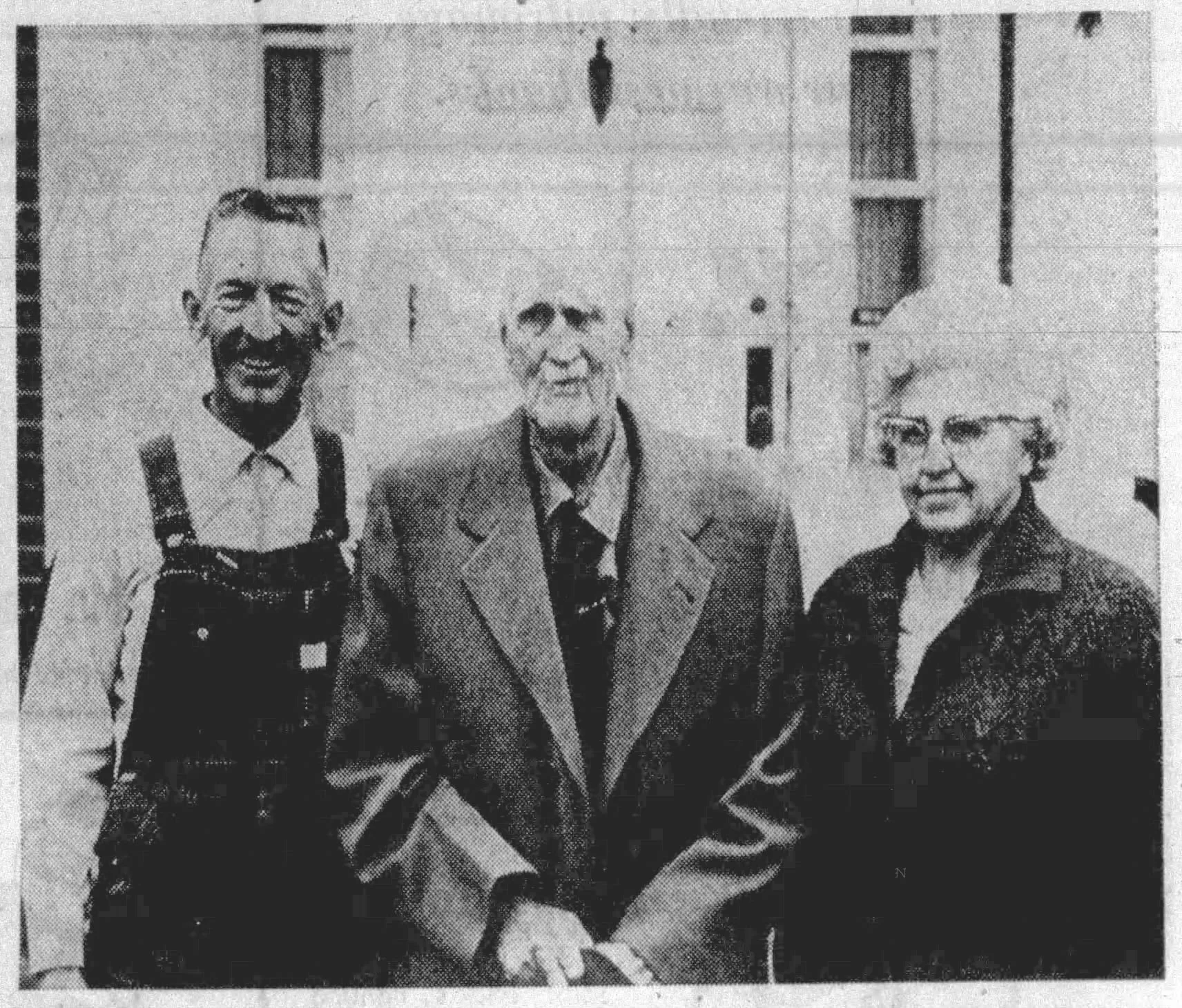
The McClarys and the infirmary’s oldest resident, December 1971: Superintendent Pat McClary, in the overalls he farmed in, and matron Margaret McClary flank Tom Bamber, at 98 the oldest of the home’s 40 residents, before the infirmary building. The photograph ran with a News Journal feature on the home that Christmas week. Pat McClary had six months to live; Margaret, 12. Courtesy of the Wilmington News Journal.
The Clinton County commissioners needed a farmer, and in April 1967 they found one near Sabina, Ohio: James Allen “Pat” McClary, who took charge of the county infirmary with his wife, Margaret, as its matron. McClary worked the institution’s land the way farmers had worked it for more than a century. He raised muskmelons on the old orchard ground south of Lytle Creek — the highest, best-drained soil on the farm. It was the most productive corner of the property.
McClary wanted the county to know the home, and in the fall of 1967 he wrote the News Journal to say so. “We want the public to know you are invited to visit us,” he wrote, “and we urge you to ‘drop in’ even if only a few minutes to say ‘Hello’ to some of our county’s older citizens, of which some haven’t any families anymore.” The residents loved visits from children, he added: “‘Oh Yes,’ some of them believe there is a Santa Claus.”
Five years later, on June 8, 1972, Pat McClary died of a heart attack in the home he managed. He was 55. The board appointed Margaret acting superintendent four days later. She died six months after that, on December 16, 1972, at 51, still in the post — two McClary superintendents lost within a year. They had lived on that land in the years when the last living marker over the burial ground still stood: a lone tree the county’s aerials tracked for two decades, gone by 1974, little more than a year after the McClarys themselves. If they knew what lay south of the creek, whatever they knew went with them.
That productive corner, a county-commissioned historical review would conclude, is also the likeliest resting place of the infirmary’s dead. They lie across the creek, beside the old orchard, in what a period newspaper called the “obscure lot” — the lost burial ground of the Clinton County Infirmary, where at least 250 men, women and children were laid to rest without headstones or recorded grave locations between 1840 and 1903. For more than a century their names survived only in the institution’s registers and the transcription work Clinton County Genealogical Society volunteers began in 2011.
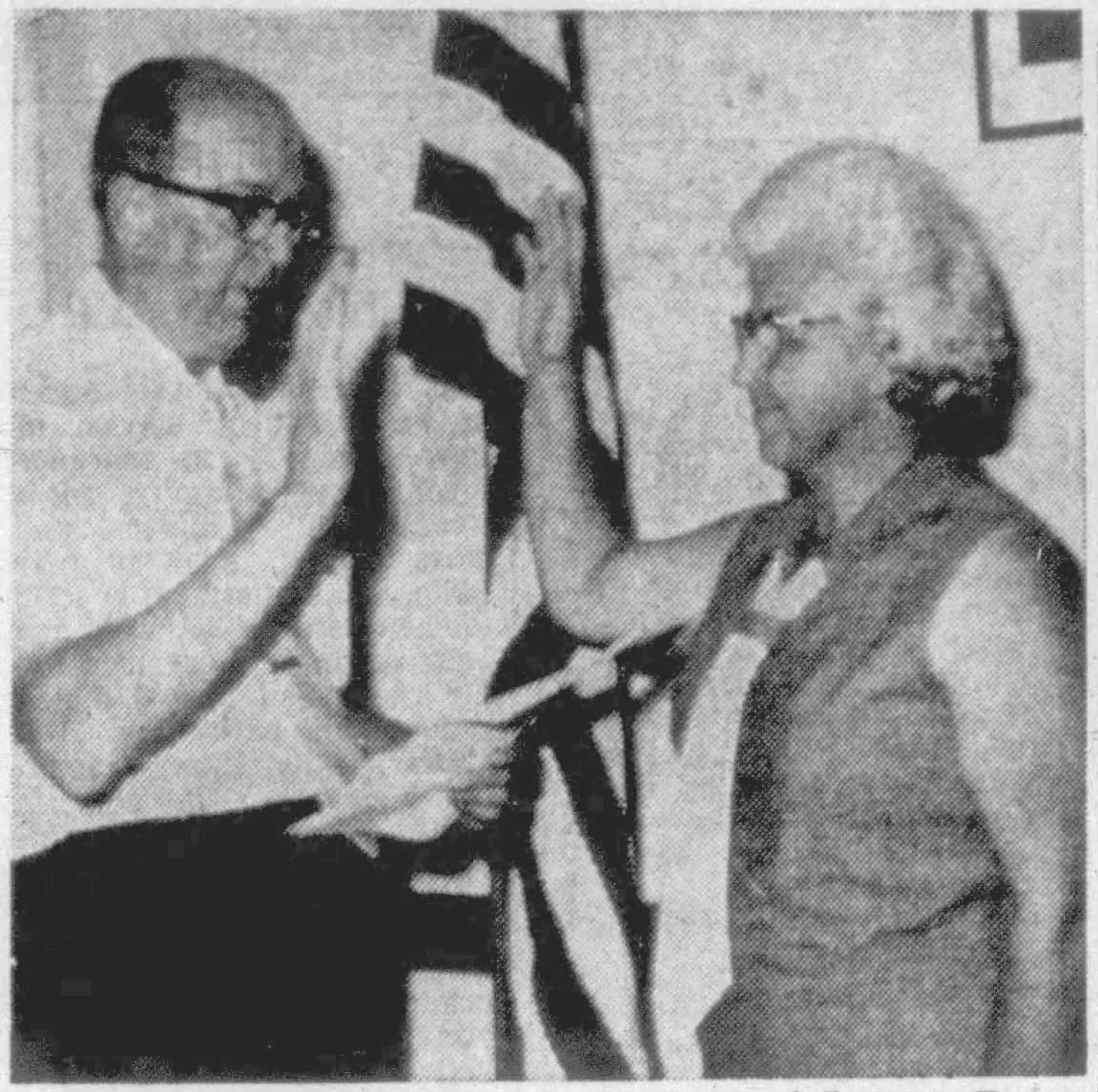
The oath of office, 1972: Margaret McClary takes the oath as acting superintendent of the Clinton County Infirmary, administered by Judge Howard D. Barns, weeks after the death of her husband, Pat, who had held the post. Formerly the home’s matron, she succeeded him and would die in office herself before the year was out — the second McClary superintendent lost in six months. Courtesy of the Wilmington News Journal.
The Home They Ran
The place the McClarys ran was a working farm. In the winter of 1971 a News Journal reporter found 40 residents living on a 121-acre spread east of Wilmington, Ohio, their ages running from 29 to 98; the oldest was Tom Bamber. The home raised its own hogs and cattle, kept a garden and seated its residents together at meals.
What the residents were to one another, the home’s next matron would put plainly a few years later: two-thirds of the people there had no families, she said, but they were all each other’s family.
The people who lived there called it home.
The Son Stays On
The family did not leave when Pat and Margaret died. In January 1973 the commissioners appointed their son, James “Jim” McClary, superintendent, with his wife, Carol, as matron. The board’s resolution recorded that the two had been “chosen from the people interviewed to serve as Superintendent and Matron of the County Infirmary.” Jim had grown up in the county and farmed near Sabina. He ran the infirmary’s land: corn for the hogs and cattle, sweet corn, a garden and one year a potato harvest dug with the residents who worked beside him.
In January 1978 the commissioners appointed Carol McClary superintendent. She held the post for seven years. She resigned effective May 31, 1985. A month later the commissioners retired the old name. From June 1985 it was formally the Clinton County Home.
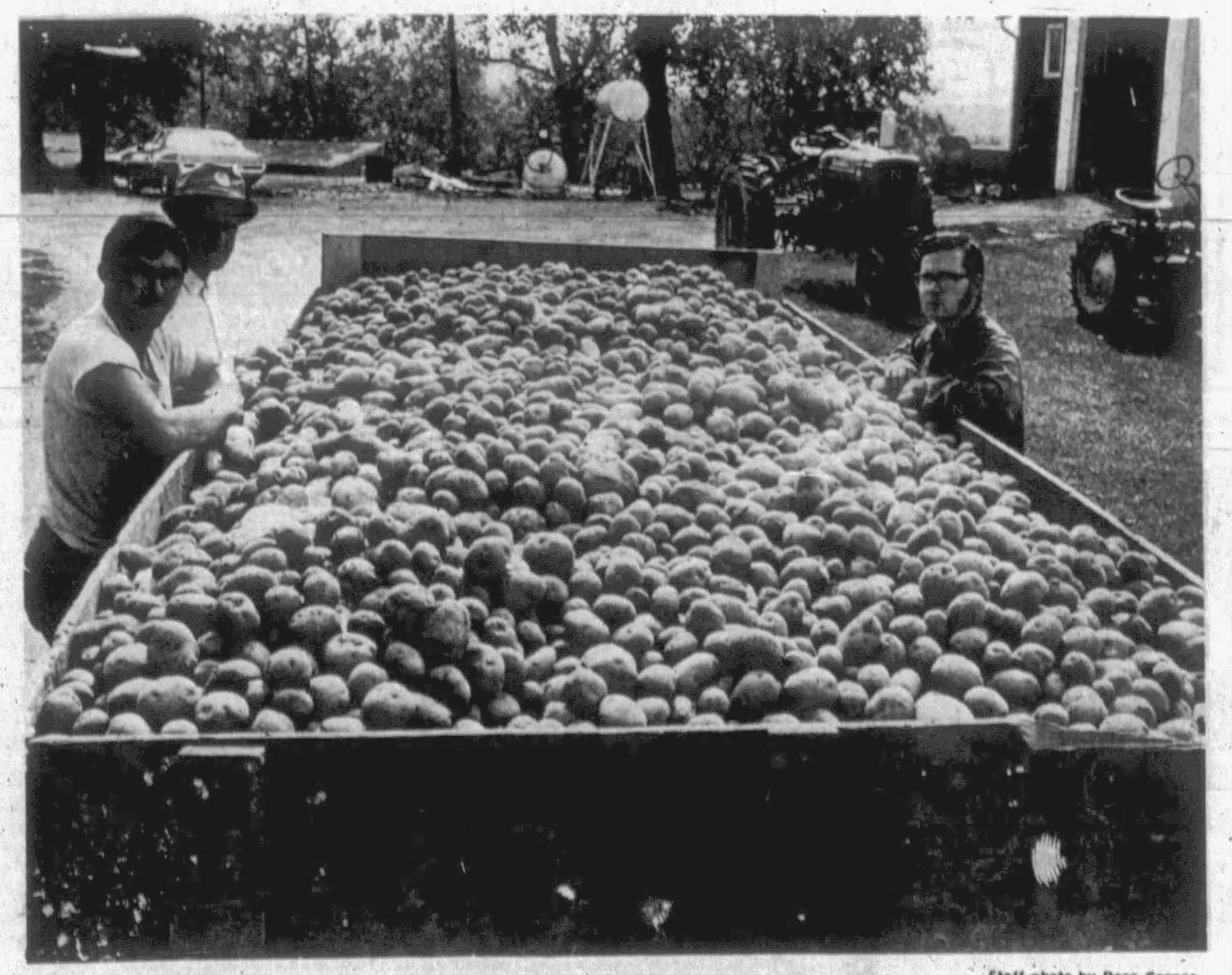
The potato harvest, 1976: Three residents of the Clinton County Infirmary — Gary Straight, Albert Talmage and Robert Wall, left to right — with a wagon holding more than 6,000 pounds of potatoes dug from the home’s garden. Superintendent Jim McClary, not pictured, planted 500 pounds of seed potatoes that spring, on Good Friday, and the four men worked an acre of ground together. The infirmary fed itself from land it farmed. Staff photo by Rose Cooper, News Journal, September 18, 1976. Courtesy of the Wilmington News Journal.
The Arithmetic Turns
They closed it four years after she was gone. On March 23, 1989, the three commissioners — Thomas C. McMillan, David R. Stewart and David E. Bailey — announced that the county home on Fife Avenue would shut its doors. The arithmetic had turned against it: 15 residents and 14 employees, on a budget near $300,000 a year. McMillan, the commission’s president, read the statement. He could not, he said, look the taxpayers in the eye and say it was worth the money. Each of Ohio’s 88 counties had once run a home like this one; by 1989 only 24 remained. The Clinton County Home was among the last of a vanishing kind.
The last superintendent, Ruth Kern, understood the decision and grieved it. When you need as many employees to run a facility as you have residents, she said, “you know it’s not going to work.” “We have to run the building,” she said, “not the residents.” On the table in the entryway, as the home wound toward its close, the guest register still lay open to signatures dated 1898. The residents told the newspaper the closing was a hard blow — that the home had been the only family some of them had, that it had been, in the words of one, not just like home but home. It had opened as a poor house. It closed as the Clinton County Home on May 15, 1989, 154 years later.
Nearly 37 years after the home closed, Jim McClary remembered the farm. He remembered his father planting muskmelons near the old orchard around 1972, the year Pat died. He did not remember a burying ground at all. In his years on that land, decades after the orchard came down and the last marker vanished, nothing on the surface said the county’s dead lay there. But asked where the old cemetery might have been, he put it past the corncrib and the barn, across Lytle Creek. It is exactly where the aerial photographs and the county-commissioned historical review place it. Told that the research pointed to the same place, he said, “You’re probably right.”
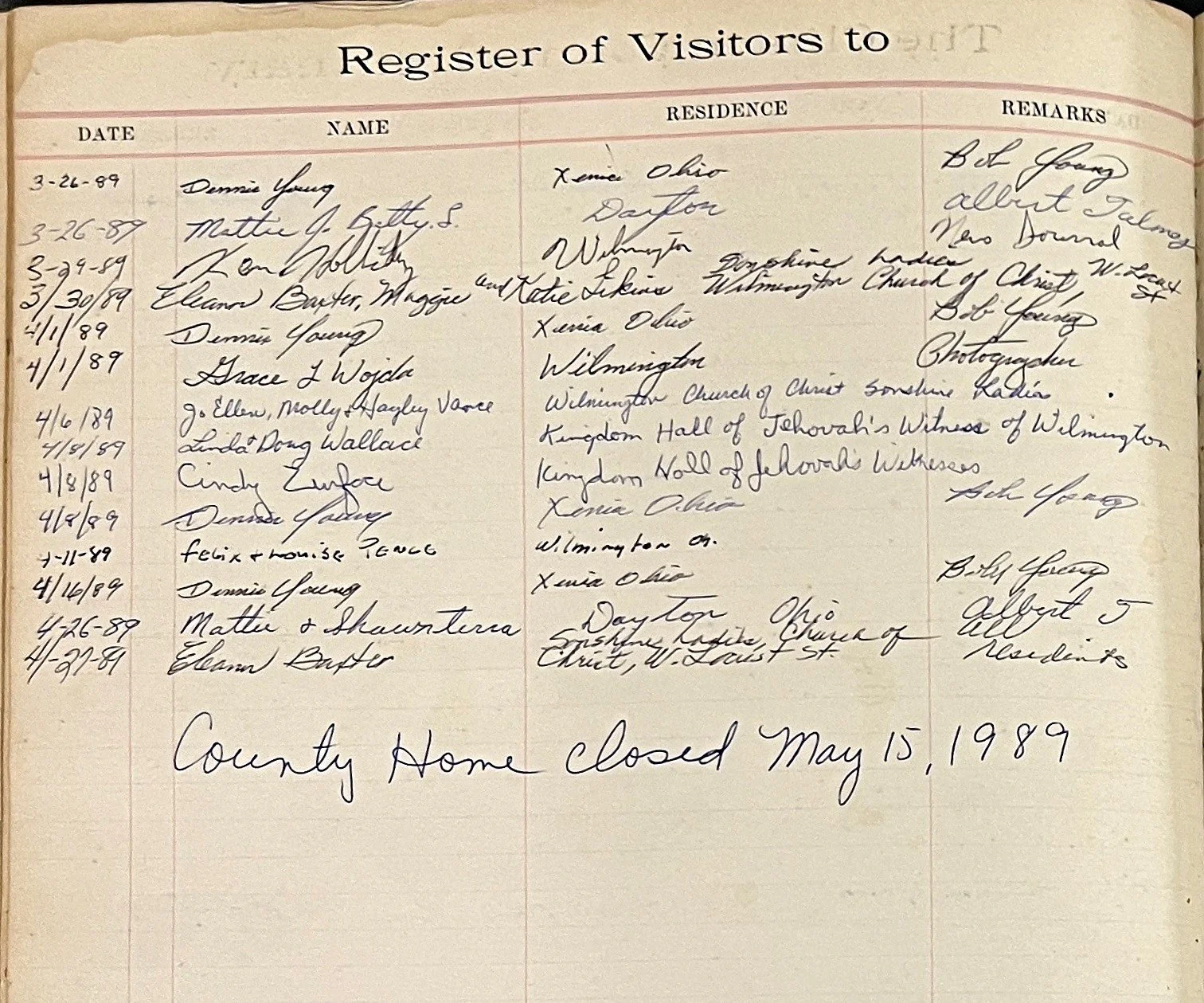
The register’s last page, 1989: The final entries in the guest register kept at the Clinton County Home since 1898 end in April 1989 — church groups and family callers to the last. Beneath them, in the keeper’s hand: “County Home closed May 15, 1989.” The page bears water staining at its upper corner; a water overflow at the courthouse in July 1989 wrecked the juvenile court’s records room and the probate judge’s office. Courtesy of the Clinton County Records & Archives.
Fife Hall and the Dog Pound
Two buildings outlived the institution, and the county sent them opposite ways. Five days before the home closed, Southern State Community College asked for the brick building the residents knew, raised in 1929 — it wanted its Wilmington campus on the farm. Six weeks later the commissioners signed a 15-year lease with an option on 40 acres, 15 being the term the state required before it would pay to renovate.
Then state Sen. Cooper Snyder, who chaired the Senate education committee and was an ad hoc member of the Board of Regents, said the money would go further at the old air base. In January 1990 Southern State canceled the lease; the renovation money, its president told the commissioners, would not be there. Wilmington College took the building instead in 1991, reopening it at 1594 Fife Avenue as a center for continuing studies, and bought it outright in 1997. It stands today as Fife Hall.
The original poor house of 1836 went the other way: it burned in 1965 and was cleared. The county dog pound stands near its site now — and had already been its neighbor for at least six years, penning the county’s strays on infirmary land since at least 1959. The humblest of the institution’s successors has the longest tenure on its ground.
The Front Acres and the Far Bank
The commissioners still own the ground — what remains of the original parcel Alexander Jennings sold the county in 1835, held now for more than 190 years. The drive back to the engineer’s office and the dog pound still carries the institution’s name on the modern map: County Home Road. The name survived when nothing else on the surface did.
The 4-C Bicentennial Trail, built in 2004, enters from Fife Avenue and runs the near side of Lytle Creek, passing the burying ground on the far bank — near the county’s dead, not over them.
In June 2026 the county engineer’s office, which sits on that land, brought the commissioners a historical review of the burying ground and urged them to keep looking — building, County Engineer Jeff Linkous told the board, on years of work by local historians, genealogists and volunteers, research he called “very valuable.” The commissioners then sent ground-penetrating radar after the graves. On July 1 they went further, proclaiming the Clinton County Infirmary Cemetery a site of historical significance and pledging to define its boundaries and preserve it permanently.
Trees stand over that ground again. The county certified the landfill closed on January 1, 1988, covered its trenches — the ridges of dumped fill still run north to south across the site — and trees went in above them, with nearly four decades to grow. Ohio EPA inspectors were still punching gas probes into the site in 2023. Even now, filling, grading, excavating, building or drilling on a closed landfill, or within 300 feet of its buried waste, requires the state’s authorization. Mowing is permitted. An orchard stood beside these graves once, until the war took it down. Whether that one was a memorial, a screen or simply good farming, the record does not say.
On the front acres along Fife Avenue the county built the Dr. Maxine Hamilton All Children’s Park, where children play on land the institution once farmed. They are not the only children on that ground. Under those trees, across Lytle Creek, lie at least 28 of the institution’s own children — 19 between the ages of 1 and 17, seven infants under a year, two stillborn — among the at least 250 the county buried there without headstones. One was a baby left on a doorstep, recorded in the register only as found. One was Seth Hale, who lived six days.
If your family’s trail has gone cold, it starts here: www.thegraveguy.com/grave-survey

